


Underground Fence vs. Physical Fence: Which is Best for Your NJ Home?
Updated: Jun 2
A six-foot wooden barrier is often nothing more than a climbing challenge for an athletic dog or a minor obstacle for a dedicated digger. You need more than just a wall; you need a boundary your dog respects. Deciding between an underground fence vs physical fence for your New Jersey home involves more than just comparing wood and wire. It's about balancing your property's aesthetics with the absolute necessity of pet safety. You should not have to choose between a beautiful yard and a secure dog.
We understand the frustration of managing a persistent escape artist while trying to navigate complex local zoning laws and high installation quotes. You deserve the peace of mind that comes from a secure yard and a well-behaved companion. This article compares the security, maintenance, and behavioral impacts of both systems to help you find the perfect containment solution. We will examine how professional calibration and specialized training turn a hidden boundary into a reliable, lifelong safety net for your family. By the end, you will know exactly which path leads to a disciplined, safe, and happy pet.
Key Takeaways
Compare the long-term maintenance of physical materials like wood and vinyl against the invisible reliability of radio-signal boundaries.
Discover why an underground fence vs physical fence is often the superior choice for large New Jersey properties with strict HOA aesthetic guidelines.
Evaluate your dog’s specific temperament and prey drive to determine if a hard barrier or a trained behavioral boundary is the safest option.
Learn why professional installation and specialized reinforcement training are the critical factors in preventing containment failure.
Understand how to integrate your containment system with expert obedience training to ensure your dog respects the perimeter every time.
Table of Contents
The NJ Homeowner’s Dilemma: Choosing the Right Boundary for Your Dog
NJ homeowners in Monmouth and Ocean Counties face a unique challenge. High property values and strict aesthetic standards make traditional fencing difficult. You want your dog safe, but you don't want your backyard looking like a fortress. This is where the debate of underground fence vs physical fence begins. In residential pockets from Middletown to Toms River, the trend is shifting toward invisible boundaries that offer security without the visual clutter. These systems allow you to maintain your property's natural beauty while ensuring your pet stays exactly where they belong.
Our climate is notoriously tough on outdoor structures. New Jersey's humid summers and freezing winters cause wood to warp and paint to peel. Traditional fences require constant maintenance to stay functional and attractive. A hidden system remains protected beneath the frost line, unaffected by the elements. Real containment isn't just about a physical wall; it's a sophisticated pet fence system that combines reliable hardware with clear behavioral expectations. You need a solution that stands up to the weather and your dog's instincts.
Common Containment Challenges in New Jersey
HOAs are often the biggest hurdle for local pet owners. Many associations in townships like Marlboro and Monroe strictly limit fence height to four feet for front yards and six feet for rears. For a high-energy dog, a four-foot picket fence is just a minor hurdle. In Mercer County, where properties often span multiple acres of wooded terrain, the sheer cost of enclosing a large lot with wood or vinyl can be prohibitive. Beyond the cost, physical barriers don't stop the 'escape artist' who specializes in digging. A dog can tunnel under a traditional fence in minutes while you're not looking.
When budgeting for such extensive property improvements, many homeowners in the tri-state area look to leverage the value of personal assets; consulting a reputable pawn shop dover de can be a practical way to secure the necessary funds for your containment system.
Identifying Your Primary Goal
Decide if you need total privacy or simple containment. If your goal is to block out the neighbors or stop a reactive dog from seeing distractions, a physical barrier serves that purpose. However, if you want to preserve your scenic NJ landscape while ensuring your dog stays on the grass, a hidden fence is the superior choice. You must balance the immediate safety of your pet with the long-term curb appeal of your home. When weighing an underground fence vs physical fence, consider if you are trying to keep your dog in or keep the rest of the world out. True peace of mind comes when you stop worrying about property lines and start focusing on the bond with your dog.
Underground Hidden Fences vs. Physical Barriers: How They Work
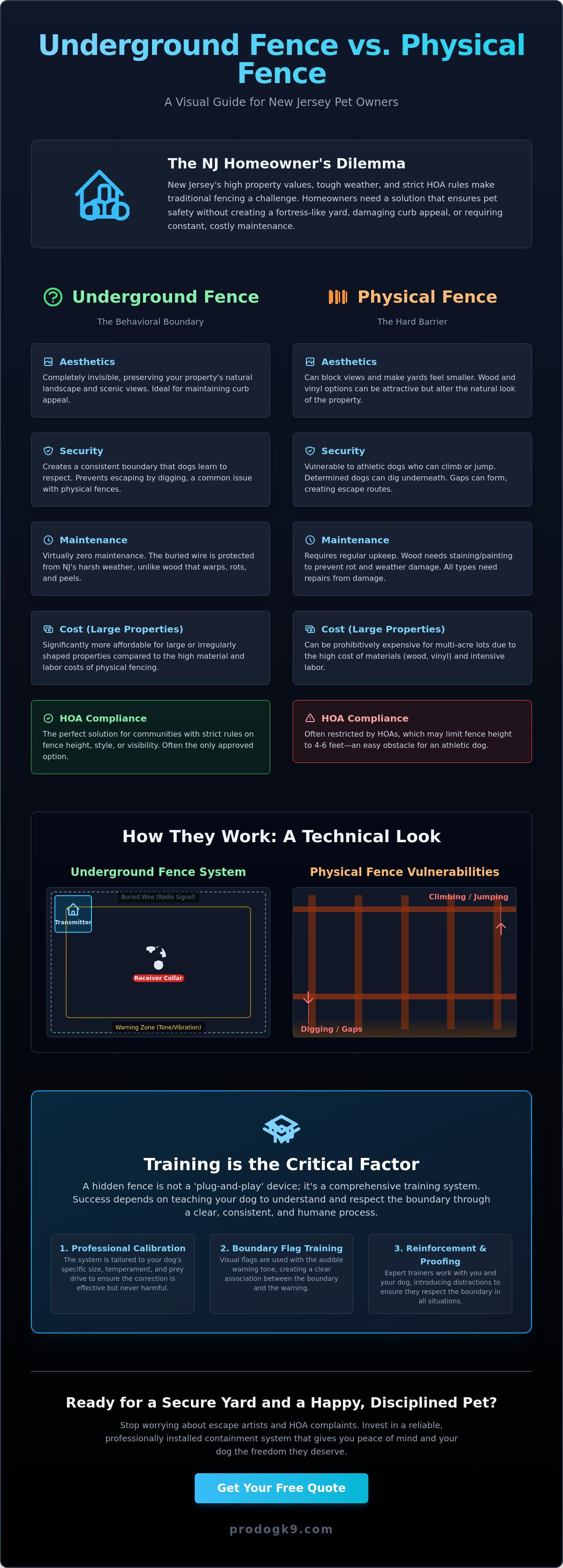
Understanding the mechanical differences in the underground fence vs physical fence debate is the first step toward a secure yard. A physical fence acts as a "hard" barrier. It relies on structural integrity to block a dog's path. Conversely, an underground system creates a "soft" boundary. It uses technology to communicate limits directly to the animal. Both require a clear understanding of your dog's physical capabilities and psychological drive. Choosing the right one depends on whether you need a visual deterrent or a behavioral boundary.
The Mechanics of Physical Fences
Physical barriers come in several forms. Vinyl is a popular choice for New Jersey families who want a clean look with zero staining or painting. Wood offers a classic aesthetic but demands frequent upkeep to prevent rot. Installing these requires digging deep post holes and strictly following property surveys to avoid neighbor disputes. However, hardware has limits. Gaps often form at the base of the fence, inviting small dogs to squeeze through or large ones to start digging. Chain link options provide containment but offer no privacy and can be easily climbed by agile breeds. The physical structure is always vulnerable to a determined animal.
The Technology Behind Underground Fencing
A professional hidden system relies on three components: a transmitter, a buried wire, and a receiver collar. The transmitter sends a radio signal through a wire buried two to six inches deep. This depth is critical. It protects the line from aerators and lawn mowers. When comparing an underground fence vs physical fence, the "soft" boundary is actually highly technical. A well-calibrated system creates a warning zone. As the dog approaches, the collar emits an audible tone or vibration. This gives the dog a chance to turn back before receiving a static correction. Success depends on more than just burying a wire. If your system isn't properly adjusted to your dog's unique personality, the boundary becomes a suggestion rather than a rule. We specialize in Invisible Fence Installation that pairs top-tier hardware with expert behavioral insight.
Static correction is often misunderstood. It is not a sharp shock. Instead, it feels like the pulse from a TENS unit used in physical therapy. It is a startling sensation designed to interrupt the dog's focus, not to cause pain. For a deeper look at how these systems impact behavior, you can research the Pros and Cons of Invisible Fences. Professional calibration ensures the correction level matches your dog's sensitivity. A high-drive German Shepherd requires a different setting than a timid Beagle. This precision is what makes a hidden system a reliable safety tool for your family.
Comparing Performance: Security, Aesthetics, and Maintenance
Deciding between an underground fence vs physical fence requires a hard look at your daily priorities. A physical barrier provides a visible "stop" sign for your dog and the outside world. An underground system offers a psychological boundary that preserves your property's character. Both have distinct advantages depending on your specific goals for security and curb appeal. You must determine if you are building a wall or establishing a standard of behavior for your pet.
The 'Intruder' Factor
Physical fences are the clear winner if you need to keep stray animals, wildlife, or unauthorized people out of your yard. Hidden systems only act on the dog wearing the receiver collar. This is a critical point raised by the Humane Society on Invisible Fences, which notes that these systems provide no protection against external threats entering your space. However, for many New Jersey homeowners with scenic or wooded lots, the priority is maintaining a connection to the landscape. Hidden fences provide 100% unobstructed views. Don't believe the common myth that a dog will always bolt through a hidden boundary to chase a squirrel. When the system is calibrated to the dog's drive, the respect for that line becomes absolute.
Maintenance is where the two options diverge sharply. New Jersey winters are notoriously brutal on physical structures. Heavy snow, ice, and high winds often lead to leaning posts, cracked vinyl, or fallen wooden panels. You'll spend spring weekends power washing, staining, or replacing broken boards to keep the perimeter functional. In contrast, hidden systems require very little physical labor. Your primary tasks are simple battery checks and occasional Invisible Fence Repair if a wire is accidentally severed during heavy landscaping or aeration. It's a choice between manual labor and simple technical oversight.
Long-Term Value and Resale
Does a physical fence add more home value? In the NJ real estate market, a well-maintained fence can be a selling point, but a weathered or rotting one is an immediate liability for a buyer. Physical fences carry high upfront costs for materials and professional labor. Hidden fences offer exceptional long-term value, especially on multi-acre lots where traditional fencing would be cost-prohibitive. Consider the recurring costs of paint and wood treatment over a decade. A hidden system's efficiency often outweighs the labor-intensive upkeep of a traditional barrier. When evaluating an underground fence vs physical fence, choose the solution that fits your lifestyle and your willingness to perform seasonal chores. Real security comes from a system that works without demanding all your free time.
When making significant financial decisions about your property or personal assets, consulting with seasoned experts is essential. For those in the region looking for professional jewelry appraisals, Dover Jewelry and Pawn Exchange provides a trusted, family-owned perspective backed by over 30 years of experience.
Selection Criteria: Which Fence Fits Your Property and Dog?
Selecting the right containment system requires an honest assessment of your dog's biology and your land's topology. An underground fence vs physical fence decision isn't just about curb appeal; it's about matching a solution to your dog's specific energy levels. High-drive breeds and athletic "jumpers" like Huskies or German Shepherds often view a standard four-foot physical fence as a minor hurdle. For these dogs, a hidden system creates a psychological boundary that a physical wall cannot provide. Conversely, if your dog has a history of aggression toward strangers, a physical barrier is a non-negotiable safety requirement to prevent direct contact with the public.
Matching the Fence to the Breed
Breed-specific traits often dictate your choice. Small breeds frequently find gaps in traditional aluminum fencing or squeeze under wooden gates. A hidden system eliminates these physical escape points. If you already have a physical fence but find your dog is digging underneath it or jumping over the top, a hidden system can act as a powerful supplement. This dual-layer approach ensures that even the most determined escape artist stays within the yard. You must choose a system that respects your dog's intelligence and physical capabilities.
High-Energy Breeds: Require the consistent, clear boundaries of a calibrated electronic system.
Small Breeds: Benefit from the lack of physical gaps found in traditional pickets.
Aggressive Tendencies: Demand a physical barrier to ensure legal compliance and public safety.
Property Layout and Terrain
New Jersey's diverse landscape presents unique installation challenges. If your property includes wooded areas, rocky soil, or steep inclines, installing a physical fence is a massive, cost-prohibitive undertaking. Hidden wires navigate through woods and across streams with minimal disruption to the environment. For waterfront properties in Ocean County, "invisible" is often the only legal option to contain a pet without violating riparian view restrictions. Towns like Freehold and Princeton frequently have strict HOA ordinances that limit or ban physical fences entirely. In these neighborhoods, a hidden system is the only way to secure your dog while staying in compliance with local rules.
Budget is the final factor. A professional physical fence for a standard backyard can easily exceed $10,000 once labor and materials are factored in. Professional hidden systems provide a more efficient path to total property containment at a fraction of that cost. Don't settle for a partial solution that leaves your dog at risk. Our team provides expert Invisible Fence Installation designed to handle the toughest NJ terrain and the most persistent dogs. When you weigh the underground fence vs physical fence for your specific home, prioritize the solution that offers the most reliability for your dog's unique personality.
Beyond the Barrier: Why Professional Training Makes the Difference
The hardware is only half the battle. When you evaluate an underground fence vs physical fence, you must recognize that a hidden system is a psychological boundary, not just a technical one. The primary reason hidden systems fail is not a wire break or a battery issue; it's a lack of proper owner and dog training. A physical wall requires no explanation to a dog, but a radio signal requires a structured introduction. Without professional guidance, a dog may become confused, fearful, or simply learn to ignore the boundary. We bridge this gap by integrating our containment solutions with proven obedience principles.
The Pro-Dog K9 Training Philosophy
We don't just install a wire; we teach your dog how to think. Our philosophy centers on clear communication rather than simple punishment. By utilizing advanced Dogtra technology, we provide a consistent signal that your dog understands. This approach moves the animal from a state of reactive panic to one of disciplined awareness. The goal is for your dog to recognize the boundary and make the conscious choice to stay in the "safe zone." We focus on building a mutual understanding that ensures your pet feels secure and confident within their limits. This specialized methodology prevents the behavioral issues often cited by critics of electronic containment.
Our 3-step process ensures total reliability:
Visual Flagging: We place temporary markers to give your dog a clear, physical representation of where the invisible line begins.
Boundary Awareness: We guide your dog through the warning zone, teaching them to retreat at the first sign of a tone or vibration.
Off-Leash Reliability: Through controlled distractions, we proof the boundary until your dog chooses the yard over any external temptation.
Professional Calibration and Support
Success requires precision. A DIY kit from a big-box store offers a one-size-fits-all approach that rarely works for high-drive New Jersey dogs. Our Master Trainers calibrate signal strength to match your dog's specific sensitivity and temperament. A timid puppy requires a different touch than a stubborn guardian breed. We provide ongoing support for local owners to handle situations where a dog might test the boundary during a high-distraction event. When you choose an underground fence vs physical fence, you are investing in a long-term safety strategy. Don't leave your pet's safety to chance with a weekend project. Schedule a consultation with our Master Trainer today to ensure your yard remains a place of disciplined companionship and total peace of mind.
Choose a Boundary That Builds a Better Bond
The decision between an underground fence vs physical fence comes down to one factor: reliable results. Physical walls offer a visual stop but require heavy maintenance and often fail to stop dedicated diggers or jumpers. Hidden systems preserve your New Jersey landscape while providing a psychological boundary that dogs truly respect. Success is not found in the wire alone; it is found in the professional calibration and training that follows. You need a solution that works for your dog's specific temperament and your property's unique terrain.
Our Master Trainer offers over 30 years of experience in behavioral modification and specialized Dogtra E-Collar training. We serve homeowners throughout Monmouth, Ocean, Burlington, and Mercer Counties with a commitment to excellence and animal welfare. We don't just install hardware; we bridge the gap between owner and animal through disciplined instruction. Stop worrying about escapes and start enjoying your outdoor space with total confidence.
Secure your property with NJ's containment experts; Contact Pro-Dog K9 Academy to schedule your professional consultation. Give your dog the freedom they deserve and give your family the security they need.
Frequently Asked Questions
Will an underground fence work for an aggressive dog?
Underground fences are not recommended as the sole containment method for dogs with severe aggression. While the system keeps your dog within the yard, it does not prevent people or other animals from entering your dog's space. This can lead to dangerous interactions or increased barrier reactivity. We recommend focusing on Aggression Rehabilitation and using physical barriers to ensure total public safety in these specific cases.
Do invisible fences hurt the dog when they get a correction?
The correction from a professional receiver collar is a startling static pulse rather than a painful shock. It is designed to feel similar to the pulse from a TENS unit used in human physical therapy. When a Master Trainer calibrates the system correctly, the sensation simply interrupts the dog's focus. It provides a clear communication signal without causing any lasting physical harm or emotional distress.
What happens to an underground fence during a power outage?
Most standard hidden fence systems will stop functioning during a power outage unless you have a dedicated battery backup. You should keep your dog on a leash or indoors if your home loses power during a storm. It is vital to check your transmitter once power is restored to ensure the signal is active. Regular maintenance checks help verify that your system remains ready for daily use.
Can a dog jump over a physical fence even if it's 6 feet tall?
Yes, many athletic or high-drive breeds can clear a six-foot fence or use the boards to climb over the top. This physical limitation is a major factor when weighing an underground fence vs physical fence. If your dog is a natural jumper, a physical wall may not be enough. In these instances, a hidden boundary acts as a necessary secondary layer to ensure your pet stays grounded.
How much does professional invisible fence installation cost in NJ?
Installation costs in New Jersey depend on your property's total acreage and the complexity of the terrain. Factors such as crossing paved driveways or navigating through dense woods will influence the labor required. Every yard is different; therefore, you should request a customized estimate. A professional assessment ensures the wire is buried at the correct depth for long-term durability and signal consistency across your entire property.
Is it possible to use an invisible fence and a physical fence together?
Combining both systems is an excellent strategy for maximum security. The physical fence provides privacy and keeps stray animals out, while the hidden system prevents your dog from digging under or jumping over the hardware. This "dual-barrier" approach is often the best solution for persistent escape artists. It allows you to enjoy the benefits of a traditional fence without worrying about its structural weaknesses.
How long does it take to train a dog to use an underground fence?
Most dogs require approximately two weeks of consistent, structured training to master the boundary. The process begins with visual markers and on-leash guidance to teach the dog where the warning zone starts. We then move to off-leash proofing with controlled distractions. Professional training ensures the dog understands how to respond to the signal correctly, which is the most critical component of a successful containment system.
Are underground fences legal in all NJ neighborhoods?
Hidden fences are generally legal throughout the state, but you must always verify your specific HOA or municipal rules. Many New Jersey communities prefer these systems because they do not alter the neighborhood's visual character. The underground fence vs physical fence debate often ends quickly in areas with strict zoning laws that ban traditional fences. A hidden system allows for safe containment without violating local aesthetic ordinances.


Comments