


Troubleshoot Invisible Fence Transmitter: A Master Trainer’s Guide (2026)
Last Tuesday, a local homeowner called our academy in a panic at 6:00 PM because their wall unit wouldn't stop chirping while their Husky was still in the yard. That piercing alarm isn't just a nuisance; it's the sound of your dog's safety net failing. You shouldn't have to be an electrician to keep your pet contained. Most owners feel immediate anxiety when those lights start flashing, especially when the average professional repair bill currently sits at $300 according to Angi’s March 2026 data. It's time to take control of your system.
This guide will teach you how to troubleshoot invisible fence transmitter issues using a Master Trainer's process of elimination. We'll show you how to diagnose beeps and signal failures right from the source so you can get your containment system back online fast. You'll discover how to decode specific light patterns and determine if you can handle a $60 DIY wire fix or if you truly need a $100 to $300 transmitter replacement. By the end of this article, you'll know exactly how to silence that alarm and confirm your fence is working without the guesswork. Let's get your peace of mind back.
Key Takeaways
Master the "Loop" concept to understand how your transmitter converts electricity into the radio signal that defines your dog's boundaries.
Follow our Master Trainer's diagnostic sequence to troubleshoot invisible fence transmitter alarms, starting at the power source to save hours of unnecessary digging.
Identify the critical symptoms that distinguish a total transmitter failure from a simple wire break, ensuring you don't waste money on the wrong parts.
Adopt the Pro-Dog K9 safety protocol to protect your dog from boundary confusion while the system is down and always physically test the signal before trusting a repair.
Discover when to transition from a DIY fix to professional repair, specifically when dealing with internal board failures or complex system calibrations.
Table of Contents
What is an Invisible Fence Transmitter and How Does It Work?
The transmitter is the command center of your entire containment system. It's a wall-mounted hub that takes standard household electricity and converts it into a specific, coded radio signal. This signal is the invisible "voice" that tells your dog where the boundary lies. If the transmitter stops talking, your dog stops listening. To effectively troubleshoot invisible fence transmitter issues, you must first respect that this unit is a sophisticated piece of canine communication technology, not just a plastic box on the wall.
Think of the system as a continuous circuit. The transmitter sends a signal out through one end of the boundary wire and expects to receive it back at the other end. This creates a "loop." When your dog's collar gets close to this loop, it picks up the radio frequency and triggers a warning or correction. You can learn more about the technical history of How Electronic Pet Fences Work to see how these systems have evolved from simple wires to the digital hubs we use today. The transmitter is the most critical safety component in your pet's environment because it monitors the integrity of this loop 24/7. If the loop is broken or the power is cut, the transmitter sounds an alarm to alert you immediately.
A standard setup includes three distinct parts: the power adapter, the surge protector, and the transmitter unit itself. Each piece must function perfectly to maintain the "Pro-Dog K9 State of Mind," where you can trust your pet is safe without constant supervision. When you troubleshoot invisible fence transmitter failures, you are often looking for a breakdown in one of these three connections rather than a failure of the unit itself.
Common Transmitter Models and Brands
Most New Jersey homeowners use systems from brands like Invisible Fence®, PetSafe®, or DogWatch®. Identifying your specific model is the first step in diagnosis. As Master Trainers, we prefer units that offer adjustable frequencies. This is vital because interference from a neighbor's fence can cause "ghost signaling," where your dog receives a correction for no reason. Professional-grade systems use specific FM or digital frequencies to ensure reliability. Always check if your unit is indoor or outdoor rated. Installing an indoor-rated unit in a damp garage or shed will lead to premature board failure and inconsistent signal strength.
The Role of the Surge Protector
New Jersey summer lightning storms are the number one enemy of electronic fences. A surge protector acts as a sacrificial barrier between the buried outdoor wire and your indoor electronics. Often, a "blown" protector will cut the signal entirely to save the unit. This mimics a total transmitter failure. A surge protector is designed to absorb high voltage spikes from lightning strikes to prevent the transmitter's internal circuit board from frying. If your transmitter is silent and dark after a storm, the surge protector is your primary suspect.
Step-by-Step Transmitter Troubleshooting: Diagnosing Beeps and Lights
When your containment system starts alarming, the "Pro-Dog K9 State of Mind" dictates a methodical, no-nonsense approach. Don't start digging up your yard based on a hunch. Most owners waste hours searching for wire breaks when the issue is sitting right in front of them on the garage wall. Before you touch a single wire, bring your dog inside. A malfunctioning system is an open gate, and your pet’s safety is the only priority. You don't need a complex multimeter for these initial steps; a simple visual inspection and a basic understanding of your unit's feedback are your best tools.
Effective troubleshooting is a process of elimination that moves from the power source outward. By isolating each component, you can determine if you're facing a simple $60 wire repair or a more involved $300 professional service call. To understand the broader context of why these systems require such precise maintenance, you can review Professional Perspectives on Electronic Fences, which highlights the importance of consistent signal reliability for canine behavior.
Step 1: Checking the Power Supply
Start with the obvious. Is the outlet actually providing power? Unplug the transmitter and plug in a lamp or phone charger to verify the circuit is live. If the outlet works, inspect the AC adapter. Look for frayed wires, heat discoloration, or chew marks from a curious puppy. For digital units, perform a "Hard Reset" by unplugging the power for 60 seconds. This clears the internal logic board and can often resolve minor software glitches that mimic a total failure.
Step 2: Interpreting Alarm Sounds and LED Indicators
Your transmitter uses a specific language of beeps and lights to tell you what's wrong. A rapid, continuous beeping usually indicates a complete break in the boundary loop. A slower, rhythmic chirping often points to a low battery in the backup system or a failing surge protector. If the lights are flashing amber, the system might be experiencing signal interference. If the unit is completely dark with no sound and no lights, the internal circuit board has likely failed, or the power adapter is dead. If these signs point toward a hardware failure, you may need professional invisible fence repair to restore your home's security.
Step 3: The Short Loop Test
This is the ultimate diagnostic tool to troubleshoot invisible fence transmitter hardware. To perform this test, take a six-inch piece of insulated copper wire and strip both ends. Disconnect your yard's boundary wires from the transmitter terminals and insert your "jumper wire" instead. This creates a tiny, perfect loop. If the beeping stops and the "loop" light turns green, your transmitter is functioning perfectly. This confirms the problem is a break in the wire buried in your yard. If the transmitter continues to beep with the jumper wire in place, the unit’s internal components are damaged and require replacement.
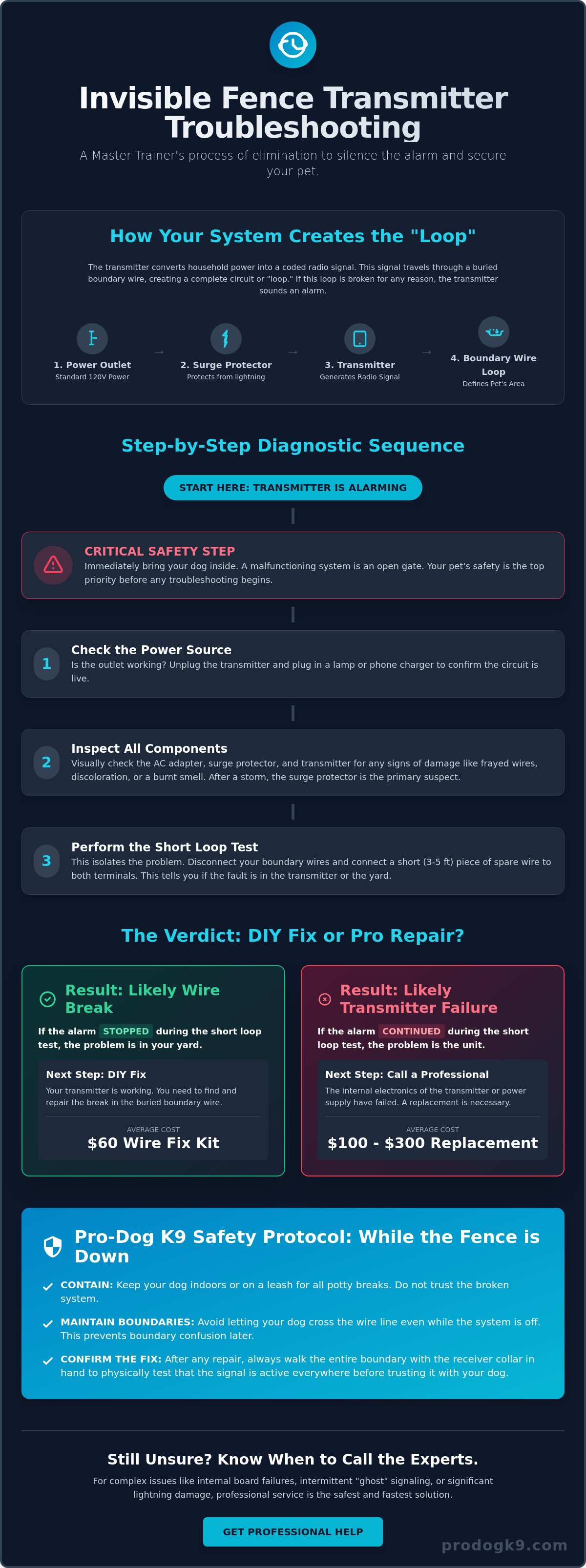
Transmitter Failure vs. Wire Break: How to Tell the Difference
The biggest mistake pet owners make is assuming a beep always means a broken wire. This diagnostic confusion leads to wasted hours digging in the yard based on a guess. While a wire break is the most common culprit, a faulty transmitter can mimic those symptoms perfectly. If you don't know the difference, you'll end up frustrated and your dog will remain at risk. You need to identify the root cause before you start labor-intensive repairs. Using a systematic approach to DogWatch's troubleshooting guide and other professional resources helps you distinguish between electronic failure and physical wire damage.
In New Jersey, our environment plays a major role in system health. Soil acidity in coastal areas can corrode connections over time, leading to signal degradation. Frost heave, the process where the ground freezes and thaws, can push wires to the surface or snap them in the middle of winter. Sometimes the system seems fine, but the collar doesn't react. This is the "Ghost Signal" phenomenon. It usually happens when the transmitter’s signal strength fluctuates due to internal board degradation. The loop is closed, but the signal isn't powerful enough to trigger the receiver. This is why it's vital to troubleshoot invisible fence transmitter performance before assuming the wire is the only problem.
Transmitter Failure Indicators
Look for physical signs of electronic distress. A burning smell or visible scorch marks on the circuit board are dead giveaways of a power surge. Humidity and heat in New Jersey summers can also cause an intermittent signal that cuts out when the unit gets too warm. The most definitive indicator is a failure to respond to the short loop test described in the previous section. If the alarm continues when you've bypassed the yard wire with a jumper, the transmitter's internal components have failed. This often happens after a lightning strike nearby, even if the unit still turns on.
Boundary Wire Break Indicators
If the alarm clears during your loop test, the transmitter is healthy. Now, look at external factors. Have you had recent landscaping, aeration, or utility work in the Monmouth County area? These are the primary causes of wire damage. Even minor gardening can nick the insulation, leading to a slow signal leak. Don't forget local pests. Burrowing animals like moles and voles often chew through lines, especially in softer soil. If the transmitter beeps but the loop test stops the noise, you are definitely looking for a break in the yard.
Safety Protocol: Managing Your Dog While the Fence is Down
When you troubleshoot invisible fence transmitter issues, your primary focus is often on the hardware. However, as Master Trainers, our focus is always on the dog’s state of mind. A containment system failure isn't just a technical glitch; it's a security breach that can undo months of behavioral rehabilitation. The moment the alarm sounds, your yard is no longer a controlled environment. You must implement a strict safety protocol immediately to prevent your dog from discovering that the "invisible wall" has vanished. Once a dog learns they can cross the boundary without consequence, you face a significant risk of boundary confusion that is much harder to fix than a broken wire.
The "Pro-Dog K9" rule is simple: never trust a "fixed" fence without a physical test. Even if the beeping stops and the lights turn green, you don't release your dog until you've verified the signal with the receiver collar in your hand. During the downtime, your dog must be on a leash for every single trip outside. This maintains the habit of staying within the designated area and prevents them from "testing" the perimeter. If you need help securing your property while you wait for parts, consider professional invisible fence repair to ensure the job is done right the first time.
Temporary Containment Solutions
Don't fall into the trap of "just letting them out for a second" to go to the bathroom. In Mercer County, where traffic density in towns like Princeton and Hamilton is high, a single distracted moment can lead to tragedy. Use a 15 to 30 foot long-line for yard exercise instead. This gives your pet freedom to move while you maintain 100 percent physical control. Most importantly, never turn the transmitter back on while the dog is outside. If the signal suddenly activates while your dog is standing near the wire, they may receive an unexpected correction that creates a lasting fear of the yard itself.
Retraining After a System Failure
Restoring the signal is only half the battle. Follow the 48-hour observation rule once the repairs are complete. For the first two days, accompany your dog outside on a leash to confirm they still respect the boundary. In Ocean County properties, where salt air and sandy soil can cause flags to deteriorate quickly, you should re-install white boundary flags to provide a clear visual reminder. This is especially vital for puppies or dogs that have only been trained within the last 12 months. Use positive praise reinforcement to reward your dog every time they turn back from the boundary signal during these re-checks. This reinforces the "Pro-Dog K9 State of Mind" and rebuilds the trust between you and your companion.
Professional Invisible Fence Repair in NJ: When to Call the Experts
DIY efforts reach a hard limit when the internal logic board of your unit fails. If your diagnostic steps from the previous sections confirmed that the transmitter is dead despite a healthy power source, you need an expert. While the average homeowner pays around $300 for professional repair according to Angi’s March 2026 report, that investment buys more than just a functioning circuit. It buys the certainty that your dog won't wander into traffic. At Pro-Dog K9 Academy, we've spent over 30 years mastering the intersection of technology and canine behavior. We know that when you troubleshoot invisible fence transmitter issues and hit a wall, you need a solution that works the first time.
High-end systems like Dogtra require precise calibration to ensure the signal remains consistent across your entire property. Professional labor for repairs generally ranges from $50 to $100 per hour. This is a small price for the "Pro-Dog K9 State of Mind," where your dog’s freedom and your peace of mind are perfectly balanced. We don't just patch wires; we calibrate the entire environment to ensure your dog understands their boundaries without fear or confusion. If your system has been compromised by a New Jersey lightning storm or years of coastal corrosion, a professional reset is the only way to guarantee safety.
The Pro-Dog K9 Advantage
We provide more than just technical support. Our Master Trainer oversight ensures that every repair is handled with an understanding of how dogs perceive their boundaries. We specialize in Dogtra E-Collar integration and complex containment setups that standard contractors can't handle. We serve homeowners across Monmouth, Ocean, Burlington, and Mercer Counties with a focus on speed and reliability. When your fence is down, every hour counts. We offer fast, local service to restore your dog's freedom and get your household back to a state of calm. We've seen every possible failure over three decades in the industry, and we have the tools to solve them all.
Scheduling Your Repair and Safety Audit
A professional diagnostic visit is a comprehensive look at your dog's safety. During our visit, we don't just troubleshoot invisible fence transmitter hardware; we conduct a full Safety Audit. This includes:
Testing the transmitter's output and signal consistency.
Checking the buried wire for signal leaks or weak points.
Inspecting the receiver collar for proper fit and battery health.
Verifying the surge protector's integrity to prevent future board fry-outs.
Don't wait for your dog to discover a gap in the fence. Secure your property with the help of NJ's top-rated experts.
and let us put our 30 years of experience to work for your family.
Restore Your Peace of Mind and Your Dog's Security
You now have the Master Trainer's blueprint to troubleshoot invisible fence transmitter issues without the typical homeowner panic. By using the short loop test and following a strict power-source-first diagnostic sequence, you've learned how to isolate hardware failures from simple wire repairs. Your dog’s safety depends on your discipline during this technical downtime. Never skip the leash-only protocol or the 48-hour observation rule once the signal is back online. Consistency is the foundation of the Pro-Dog K9 Academy State of Mind.
If your DIY efforts have reached their limit or your high-end Dogtra system needs precision calibration, don't leave your pet's life to chance. Pro-Dog K9 Academy brings 30+ years of Master Trainer experience and 300+ 5-star reviews to every New Jersey home we serve. We specialize in both technical containment and behavioral rehabilitation, ensuring your system provides a real-life safety net for your companion. Stop the beeping and secure your dog. Book a Pro-Dog K9 Academy Repair Visit. You've got the tools to handle this, and we're ready to help you return to the calm of a well-mannered, safely contained pet.
Frequently Asked Questions
Why is my invisible fence transmitter beeping every second?
Rapid beeping typically signals a break in the boundary loop that prevents the radio signal from completing its circuit. While this often means a wire was cut during landscaping or aerating, it can also indicate a loose terminal connection at the wall unit. Always perform the short loop test first to isolate the hardware. This simple check prevents you from searching for a wire break in the yard that might not exist.
Can a power surge break my dog fence transmitter?
High voltage surges from NJ lightning storms are the primary cause of internal circuit board failure. If your surge protector is over two years old, it may have lost its ability to absorb these spikes effectively. A fried board often smells like burnt plastic or shows visible scorch marks. When you troubleshoot invisible fence transmitter damage after a storm, check the protector status light before assuming the unit is dead.
How do I reset my invisible fence transmitter after a power outage?
Reset your unit by unplugging the power adapter from the wall for exactly 60 seconds. This allows the internal capacitors to discharge fully and clears software glitches caused by the power fluctuation. Plug the unit back in and watch the LED sequence stabilize. If the alarm persists after this hard reset, the system has detected a physical fault in the loop or the hardware that requires further investigation.
What does a red light on my dog fence transmitter mean?
A solid or flashing red light usually indicates a system error or a broken boundary wire. On most professional units, this light is paired with an audible alarm to ensure you notice the containment failure immediately. Some specific models also use red to signal a dead backup battery or a failure in the transmitter's output stage. Check your model's specific light codes to determine if the fault is internal or external.
Is it safe to leave my transmitter beeping overnight?
Leaving the unit beeping won't damage the electronics, but it confirms your dog is no longer contained. The alarm is designed to be intrusive so you don't ignore the fact that your pet's safety net is down. Your dog's security is the only priority; keep them on a leash or inside until the signal is restored. Don't silence the alarm and then forget the "invisible gate" is wide open.
How can I tell if my transmitter is broken or if there is a wire break?
Use a two inch jumper wire to bypass your yard's boundary loop at the transmitter terminals. If the alarm stops when the jumper is connected, your transmitter is healthy and you have a wire break somewhere in the yard. If the beeping continues during this test, the transmitter's internal components are damaged. This test is the most reliable way to troubleshoot invisible fence transmitter hardware without specialized tools.
Do I need to replace the whole transmitter if the power cord is damaged?
You don't need to replace the entire transmitter if only the AC adapter or power cord is damaged. Most manufacturers sell replacement adapters that are easy to swap out. However, you must ensure the replacement matches the original voltage and amperage specifications exactly. Using an incorrect power supply can permanently fry the transmitter's logic board, leading to a much more expensive professional replacement visit.
Will my invisible fence work if the backup battery is dead?
Your fence will function perfectly without a backup battery as long as your home's main power is active. The battery is a secondary safety feature designed to maintain the boundary loop during local power outages. If your battery is over three years old, it likely won't hold a charge during an emergency. Replace it to ensure your containment remains intact even when the lights go out.


Comments