


Puppy Training 101: The Master Trainer’s Guide to a Well-Behaved Dog
Updated: May 31
Your puppy doesn't need another chew toy; they need a leader who speaks their language. Right now, you're likely exhausted from midnight crate crying and frustrated by the constant nipping at your heels. It's common to feel overwhelmed when housebreaking fails, especially when you're part of the 53 percent of U.S. households currently raising a dog. You expected a loyal companion, but it feels like you've invited a tiny whirlwind of domestic chaos into your living room. Success in puppy training 101 starts with understanding why your dog acts out and how to reclaim your role as the head of the household.
Mastering these essentials is about more than teaching simple tricks. It's about establishing a professional communication system in the environment where your dog actually lives. This guide delivers a master trainer's blueprint designed for real-world results at home. You'll gain the confidence to lead effectively, ensuring your puppy sleeps through the night and respects your boundaries. We will explore the essentials of crate success, housebreaking efficiency, and the specific behavioral corrections needed to stop mouthing before it becomes a permanent habit.
Key Takeaways
Identify the critical imprinting window between 8 and 16 weeks to prevent long-term behavioral issues before they start.
Master the essentials of puppy training 101 by establishing a clear pack dynamic using a proven "Firm but Fair" communication philosophy.
Protect your puppy's health and accelerate learning by training in your home environment where real-world distractions actually happen.
Implement the "praise and timing" method to achieve a mess-free home while transforming the crate into a stress-free sanctuary.
Set the stage for lifetime safety by integrating advanced boundaries and specialized tools designed for reliable off-leash control.
Table of Contents
What is Puppy Training 101? Defining the Foundation
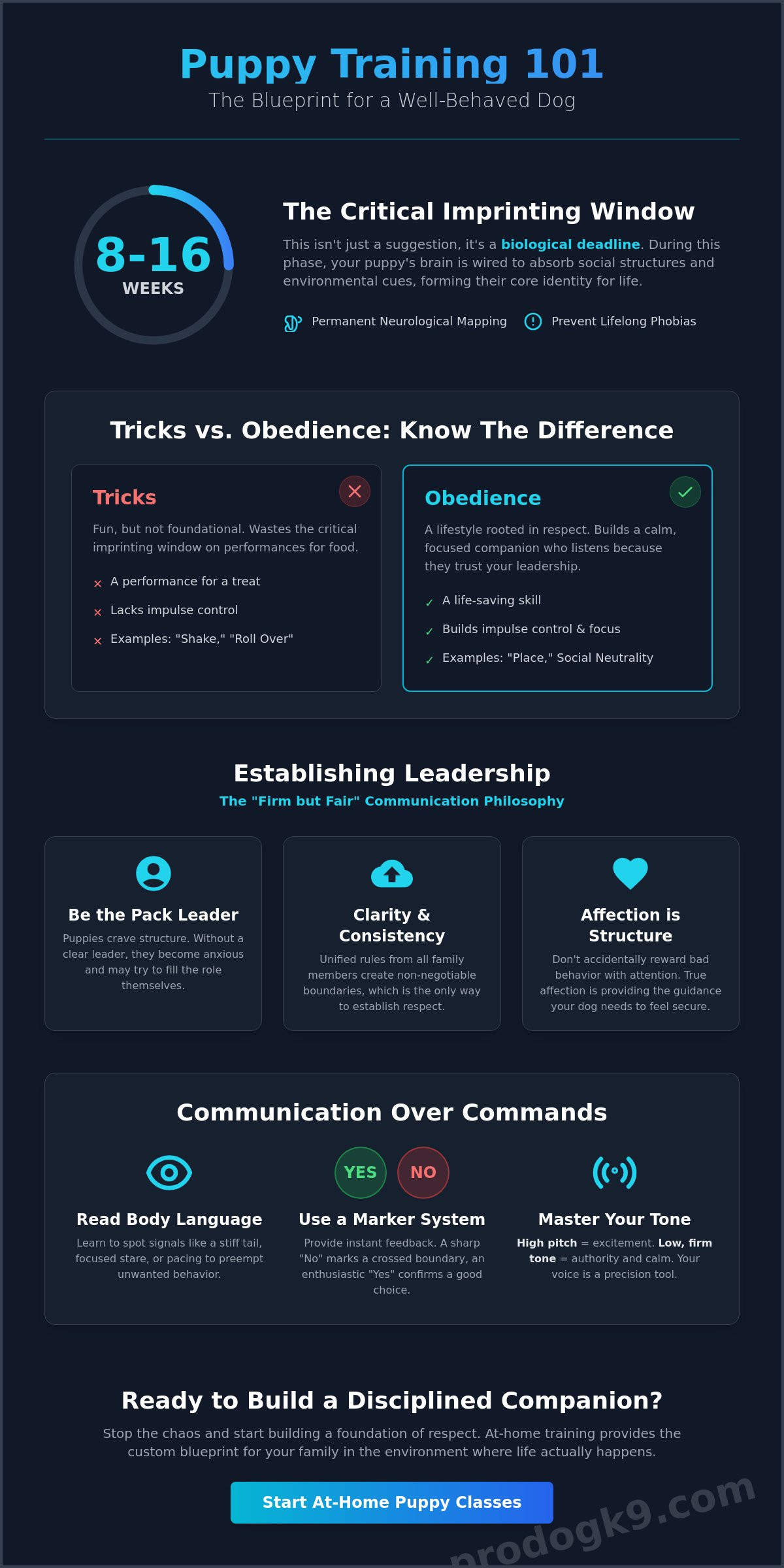
True puppy training 101 isn't just a collection of tips for new owners. It's a biological deadline. The window between 8 and 16 weeks of age represents the most critical developmental phase in a dog's life. During this time, your puppy's brain is physically wired to absorb social structures and environmental cues. This isn't just a suggestion for when to start; it's the period where you define the animal's entire future. The goal is to create a dog that's a pleasure to live with, meaning they respect your space, remain calm under pressure, and understand their role within your family pack.
To ensure you make the most of this critical developmental window, you can learn more about professional training programs that provide a structured blueprint for long-term behavioral success.
The Critical Developmental Window
The first few months dictate the next decade of your dog's behavior. This is the imprinting phase, a time when every interaction leaves a permanent mark on their psyche. If you allow bad habits like jumping or nipping now, you're essentially programming those behaviors into their core identity. Early mistakes are notoriously difficult to undo because they bypass simple learning and become instinctual. Puppy imprinting is the permanent neurological mapping of social boundaries.
You must also navigate specific "fear periods" during this window. These are brief stages where a puppy may suddenly become terrified of everyday objects or sounds. Handling these moments with confident leadership prevents lifelong phobias. Effective Dog training during this stage focuses on exposure without overstimulation. You aren't just teaching commands; you're building a resilient mind that can handle the stresses of the human world.
Tricks vs. Obedience: Knowing the Difference
Many owners waste this precious time teaching "Shake" or "Roll Over." While these are fun, they aren't obedience. A trick is a performance for a treat, but obedience is a lifestyle rooted in respect. For example, "Place" is a life-saving skill that requires the dog to stay on a specific mat or bed until released. To find the ideal bed for this training, you can discover MyCartGoods.com for high-quality comfort products and innovative pet technology. This command builds impulse control and provides the dog with a job to do when guests arrive or during family meals, highlighting the difference between a dog that performs for food and a dog that listens because they respect your leadership.
Foundational puppy training 101 also prioritizes social neutrality. You don't want a dog that thinks every person or animal they see is an invitation to play. A neutral dog can observe a cyclist, a squirrel, or another barking dog while remaining focused on you. This level of focus starts with establishing yourself as the most relevant thing in their environment. It requires absolute consistency across all family members. If one person allows the puppy on the sofa while another forbids it, the dog learns that your rules are optional. Clear, unified boundaries are the only way to move from domestic chaos to disciplined companionship.
Establishing Leadership: The Pro-Dog Communication Philosophy
Leadership is the silent language of a well-behaved dog. While many programs focus solely on bribing puppies with treats, true success in puppy training 101 requires a "Firm but Fair" methodology. This philosophy, rooted in 30 years of Master Trainer experience, recognizes that dogs are pack animals. They don't view your family as a group of roommates; they view it as a social hierarchy. Without a clear leader, a puppy feels obligated to fill that role themselves, leading to the very domestic chaos you're trying to avoid.
You can't love a dog into being obedient. In fact, many owners accidentally reward bad behavior with affection. Giving a puppy attention when they jump or bark only reinforces the chaos. True affection is providing the structure they crave. A balanced approach uses positive reinforcement to reward good choices, but it also establishes non-negotiable boundaries. This clarity is what creates a confident, calm companion. If you want to see how this looks in your own living room, consider starting with at-home puppy classes to build a custom blueprint for your family.
Communication Over Command
Effective training starts with reading your puppy's body language before a lunging bite or an accident occurs. A stiff tail, a focused stare, or a specific pacing often signals an impending action. Use a marker system to provide instant feedback. A sharp "No" marks the exact moment a boundary is crossed, while an enthusiastic "Yes" confirms a job well done. Your tone of voice is a precision tool. Use it to guide, not to intimidate. High-pitched tones build excitement; low, firm tones project authority and calm. This immediate feedback loop bridges the gap between species.
The Role of the Pack Leader
Puppies crave structure. Without it, they become anxious and reactive. Being a pack leader means controlling the resources and the environment, a principle that Tails On Trails Pet Resort integrates into their professional care and daycare services. Set physical boundaries early to establish respect and consider these non-negotiables:
The Kitchen: This area is off-limits during family dinner times to prevent begging.
The Bedroom: Use this as a sanctuary for rest, not a playground for high-energy wrestling.
The Yard: Establish specific zones for bathroom breaks versus play to maintain focus. To keep these areas sanitary, professional waste removal services like Scot Pooper Scoopers set a high standard for maintaining a clean environment for both training and play.
Establishing these rules now prevents future aggression and separation anxiety. When a puppy knows you are in control of the environment, they don't feel the need to guard resources or panic when you leave the room. Leadership isn't about being a "boss"; it's about being a reliable mentor who provides safety through structure.
This commitment to safety and structure should also guide your choice of professional care facilities when you travel. For pet owners who value high standards of boarding and comfort, you can discover Noah's Pet Hotel & Spa to see how they provide a secure and relaxing environment for dogs, cats, and even exotic pets, serving as a model for quality care.
Why At-Home Puppy Training Beats Group Classes
Group classes are often sold as the gold standard for puppy training 101, but they carry significant hidden risks. Safety is the primary concern for any new owner. Puppies typically don't receive their final round of core vaccinations until 16 weeks of age. Dragging a vulnerable animal into a public facility filled with unknown dogs exposes them to parvovirus and other dangerous pathogens before their immune system is ready. At-home training eliminates this danger. It allows you to focus on behavioral foundations without risking your dog's health. You receive the undivided attention of a Master Trainer instead of competing with ten other distracted owners in a noisy, chaotic room.
Training in the Natural Environment
A puppy who listens in a quiet pet store aisle will often fail at your front door. Behavior is context-specific. Training where the problems actually happen is the only way to achieve reliable, real-world results. We address the specific triggers of your unique household: the doorbell ringing, the mailman approaching, or squirrels darting across the yard. For residents in Monmouth and Ocean County, at-home puppy classes provide a convenient solution that transforms your living room into a controlled learning environment. This approach ensures your dog respects the sofa and the foyer, not just a rubberized training center floor.
Many pet owners also share their homes with other animals, requiring a balanced approach to household safety. If you're looking for specialized supplies or guidance for non-canine companions, visiting a reputable exotic bird store New Jersey can provide the necessary resources to keep your entire animal family thriving.
The Socialization Myth
Many owners confuse socialization with constant interaction. They believe their dog must greet every stranger and play with every puppy to be well-adjusted. This is a dangerous misconception that often leads to overstimulation and leash reactivity. True socialization is the absence of a reaction to the environment. It means your puppy can observe the world while remaining neutral and focused on your leadership. You don't need a crowded park to achieve this; you need controlled exposure.
You can safely socialize your puppy at home before their final shots are complete. Introduce them to the sound of the vacuum, the sight of umbrellas, or different floor textures like tile and hardwood. Use these controlled exposures to build confidence without the unpredictable chaos of a group class. This strategic approach to puppy training 101 prevents developmental fear periods from turning into lifelong anxieties. By prioritizing neutrality over interaction, you develop a dog that is calm in public and respectful at home. Our professional at-home obedience training focuses on these environmental milestones to ensure your puppy grows into a disciplined, confident companion.
The Essential 101 Checklist: 5 Skills Every Puppy Needs
Most owners prioritize "Sit" or "Stay," but these commands won't save your sofa or your sanity. Professional puppy training 101 focuses on functional skills that integrate your dog into your daily life. We prioritize behaviors that prevent destruction and foster mutual respect. These five skills form the bedrock of a well-behaved companion:
Crate Training: This creates a sanctuary for your dog. It prevents separation anxiety and ensures they have a safe place to rest when you cannot supervise them.
Housebreaking: Success relies on the "praise and timing" method. You must catch them in the act of doing the right thing to build a mess-free home.
Leash Manners: Start this foundation early. A dog that walks politely on a leash is a dog you can actually take out into the community.
Bite Inhibition: Puppies must learn that human skin is off-limits. Teaching them to control the pressure of their mouth is a non-negotiable safety requirement, and providing durable chew toys from Panda Cows is an effective way to redirect this natural behavior.
The "Place" Command: This is the ultimate tool for a calm household. It gives your dog a specific boundary to stay within during family dinners or when guests arrive.
Mastering the Crate and Housebreaking
Potty success is a game of timing and consistency. A general rule for daytime breaks is one hour for every month of age. A three-month-old puppy typically needs a trip outside every three hours. When they eliminate outside, provide immediate, calm praise. If they whine in the crate, wait for a moment of silence before releasing them. Rewarding noise with attention creates a demanding adult dog. To get a customized schedule for your specific home layout, investigate In-Home Puppy Classes NJ.
Curbing Nipping and Destructive Chewing
Puppies explore their world with their mouths. However, you must redirect this energy to appropriate toys immediately. The "Ouch" method involves a high-pitched yelp to startle the pup into releasing your hand. If this yelp overstimulates your dog, switch to a firm "No" and offer a durable chew toy instead. Destructive chewing is often a symptom of boredom rather than malice. Provide mental stimulation through structured play and boundary work to keep their minds occupied. Ready to transform your household? Secure your spot for at-home obedience training today and stop the destruction before it becomes a habit.
Beyond the Basics: Long-Term Safety and Boundaries
Successfully completing puppy training 101 is only the first chapter of your dog's development. Once you've established a clear communication system and established respect at home, you must look toward long-term safety and environmental freedom. Your goal isn't just a dog that listens in the living room; it's a dog that remains reliable in an open field or a busy neighborhood. This transition requires moving from physical leashes to psychological boundaries, utilizing advanced tools designed for precision and safety. Pro-Dog K9 Academy serves as your dedicated mentor through every stage of this journey, ensuring your dog remains a disciplined companion for life.
The Path to Off-Leash Freedom
Off-leash freedom is the ultimate reward for a disciplined dog, but it's a privilege that must be earned through a solid foundation. You cannot jump straight to remote training without the core principles established during your initial puppy training 101 sessions. Professional guidance is essential to ensure that tools like the Dogtra E-collar are used as a refined communication device rather than a crude punishment. We provide specialized at-home instruction to calibrate these tools to your dog's specific temperament and sensitivity levels. This professional touch transforms technology into a reliable bridge, allowing for instant feedback even at a distance. When used correctly, these tools provide the safety net required for your dog to explore the world without the restriction of a physical cord.
Securing the Yard in Monmouth and Mercer Counties
Yard containment is a critical component of animal welfare, especially for homeowners in Monmouth and Mercer Counties where property sizes vary significantly. While many attempt DIY fence kits, these often fail due to poor wire placement or a complete lack of behavioral integration. A professional Invisible Fence installation creates a secure environment where your dog understands their physical limits. We don't just bury a wire; we train the dog to respect the "Invisible Boundaries" of your specific property. This dual-service signature combines physical safety solutions with behavioral discipline. It ensures your dog stays on your property even when high-value distractions, like a local delivery truck or a neighborhood squirrel, appear at the edge of the lawn.
Don't leave your dog's safety to chance or amateur methods. Moving beyond the basics requires a comprehensive approach that addresses both behavior and physical containment. Whether you need to secure a new perimeter or require Invisible Fence repair for an existing system, the experts at Pro-Dog K9 Academy provide the calibration necessary for real-world reliability. Secure your property and your peace of mind by scheduling a consultation for professional installation and advanced obedience training today. We are here to ensure your puppy grows into a safe, respectful, and truly free adult dog.
Transform Domestic Chaos into Disciplined Companionship
The window for effective puppy training 101 closes quickly. You've learned that success depends on establishing clear leadership within those first critical months and training in the actual environment where your dog lives. By prioritizing a "Firm but Fair" philosophy over simple tricks, you ensure your puppy respects your home and your rules from the start. This foundation is what separates a stressful pet ownership experience from a lifetime of rewarding companionship.
Maintaining this foundation also means selecting the right environment for your dog when you are away. For those seeking professional care that aligns with high behavioral standards, Tails On Trails Pet Resort provides a structured and safe space for boarding and daycare.
Stop struggling with sleepless nights and ruined furniture. Our results-oriented approach focuses on the real-world challenges you face every day. With over 30 years of industry experience, our Master Trainer provides the professional blueprint you need to build a bond based on mutual respect. We proudly serve families throughout Monmouth, Ocean, Burlington, and Mercer Counties with at-home solutions that work. Schedule Your In-Home Puppy Training Session with a Master Trainer to start your journey today. Your puppy is ready to learn; they just need you to lead. You can achieve the calm, well-behaved dog you've always wanted.
Frequently Asked Questions
When should I officially start puppy training 101?
Start training the moment you bring your puppy home. The critical developmental window for puppy training 101 is between 8 and 16 weeks of age. Waiting until they are older allows bad habits to become neurologically mapped behaviors. Establishing leadership and house boundaries on day one prevents domestic chaos and sets the foundation for a lifetime of disciplined companionship.
Is at-home puppy training more effective than group classes?
At-home training is significantly more effective because it addresses behaviors in the environment where they actually occur. Puppies often perform well in a sterile classroom but fail at your front door or on your sofa. Training at home also eliminates the risk of exposing unvaccinated puppies to dangerous pathogens in public facilities. You get the undivided attention of a Master Trainer to solve house-specific triggers immediately. To understand the investment required for such personalized coaching, you can learn more about the factors that influence professional training rates.
How long does it take to fully housebreak a puppy?
Most puppies can be reliably housebroken within 4 to 8 weeks if you follow a rigorous praise and timing schedule. Success depends entirely on your consistency and the puppy's age. A three-month-old pup physically cannot hold their bladder for more than a few hours. Use a crate to prevent accidents and ensure you are present to reward successful outdoor elimination every single time.
What is the most important command a puppy should learn first?
The Place command is the most vital skill for a calm household. It teaches your puppy to remain on a specific mat or bed until released, which builds essential impulse control. While Sit is a basic trick, Place is a functional obedience tool that manages your dog's energy when guests arrive or during family meals. It establishes your role as the leader who controls the environment.
Can I start invisible fence training with a young puppy?
You can begin Invisible Fence training once your puppy is approximately 4 to 5 months old and has a basic understanding of obedience commands. It is crucial to have a professional install and calibrate the system to your dog's specific size and temperament. DIY kits lack the specialized behavioral training required to ensure your puppy understands the boundary without experiencing unnecessary anxiety or confusion.
How do I stop my puppy from biting and nipping at my kids?
Stop nipping by immediately redirecting the puppy's mouth to an appropriate toy and using a firm No marker. Children often move in ways that trigger a puppy's prey drive, so you must supervise all interactions. Teach your kids to stand still like a tree if the puppy gets too excited. Consistent feedback ensures the puppy learns that human skin is a non-negotiable boundary that must be respected.
Do you provide puppy training in Burlington and Mercer County?
We provide professional at-home puppy classes and obedience training throughout Burlington and Mercer Counties. Our mobile services also extend to Monmouth and Ocean Counties. We bring the expertise of a Master Trainer directly to your living room or yard, ensuring your dog learns to behave in the real-world environment where they spend their time. This local, grounded approach allows for flexible scheduling and personalized instruction.
What equipment do I need for basic at-home puppy training?
Start with a properly sized crate, a standard six-foot leash, and a flat buckle collar. You will also need high-value rewards to reinforce positive choices during the initial stages of puppy training 101. As your dog progresses, we may introduce specialized tools like a Dogtra E-collar for off-leash reliability. Having the right equipment ensures you can communicate clearly and maintain physical control while building a foundation of mutual respect. Furthermore, providing specialized nutrition from a trusted source like Garden State Pet Center helps maintain the health and focus necessary for a successful training journey.


Comments