


Is an Invisible Fence Safe for My Dog? The Master Trainer’s Guide to Pet Containment
Updated: Jun 15
Safety isn't found in a buried wire; it is found in the expert calibration of the correction and the professional training of the dog. If you are asking, "is an invisible fence safe for my dog," you are likely caught between the desire for a secure yard and the fear of causing your pet pain. You want the freedom of an open property but worry about the reliability of the technology or the potential for behavioral side effects. This hesitation is natural for any responsible owner who views their dog as a family member.
I understand the frustration of navigating conflicting online opinions and the anxiety of wondering if your dog will stay put. With 30 years of experience as a Master Trainer specializing in canine behavior and containment, I have seen exactly what works and what doesn't. This guide provides the clarity you need to move from domestic chaos to disciplined companionship. You will discover how modern systems utilize humane technology, why the training process is the most critical factor for success, and how to ensure your dog remains secure without fear or stress.
Key Takeaways
Reframe the underground containment system as a sophisticated communication tool that uses a warning hierarchy rather than a simple punishment device.
Understand why the answer to "is an invisible fence safe for my dog" depends entirely on expert calibration and a professional three-step training protocol.
Identify the hidden safety hazards of DIY installations, such as signal bleeding and dead spots, which often lead to pet confusion and escape attempts.
Evaluate your dog's specific temperament and prey drive to determine how specialized training can prevent them from breaking the boundary for distractions.
Discover why integrating professional obedience training is the only way to guarantee a secure yard and true peace of mind for your family.
Table of Contents
The Safety Debate: Decoding How Invisible Fences Actually Communicate
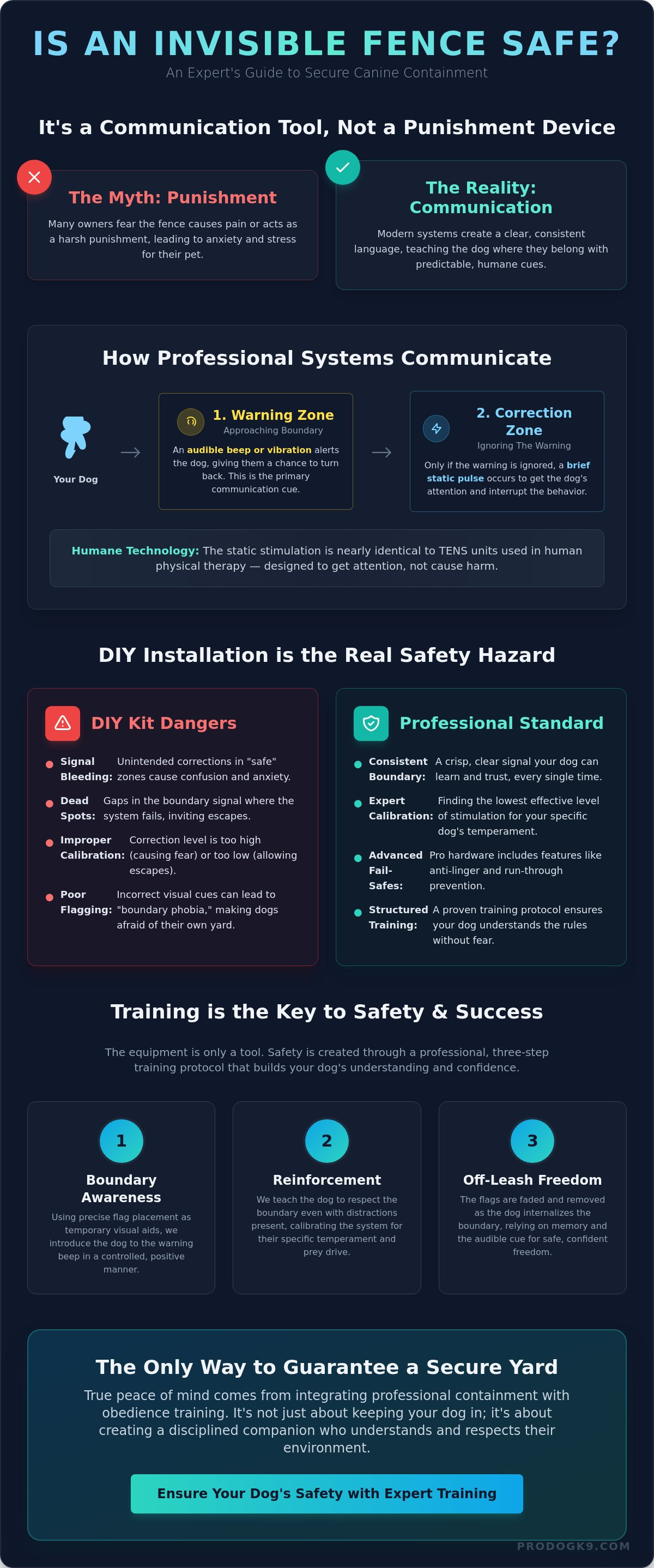
If you want to know if an invisible fence is safe for my dog, you must first stop viewing it as a punishment tool. Modern underground containment is a sophisticated communication system. It creates a clear, consistent language between you and your pet. Many owners worry about the "shock" associated with these fences. In reality, professional systems use static stimulation. This technology is nearly identical to the TENS units used in human physical therapy. It is designed to get the dog's attention and interrupt a specific behavior, not to cause physical harm.
Safety is not a byproduct of the equipment alone; it is a result of expert calibration. As a Master Trainer, I prioritize finding the lowest effective level of stimulation for every individual animal. We use a structured hierarchy to teach the dog where they belong. Understanding How Invisible Fences Work involves recognizing these two distinct zones:
The Warning Zone: An audible beep or vibration alerts the dog as they approach the boundary.
The Correction Zone: A brief static pulse occurs only if the dog ignores the initial warning.
When asking "is an invisible fence safe for my dog," remember that clarity is the ultimate safety feature. When a dog understands exactly where the limit lies, they don't experience the stress of uncertainty. They simply learn to respect the line.
Communication vs. Punishment: The Psychological Shift
Dogs thrive when they understand the rules of their environment. Clear boundaries actually reduce canine anxiety by providing a predictable world. The audible warning beep serves as a vital non-physical cue. It allows the dog to make a choice and self-correct before any physical sensation occurs. This shift from "avoiding pain" to "following a cue" is what distinguishes professional behavioral modification from primitive correction methods.
Modern Technology and Safety Fail-Safes
Professional-grade hardware from NJ Dog Fences includes critical fail-safes that cheap, big-box store kits ignore. Features like "anti-linger" prevent a dog from standing in the warning zone and draining the collar battery. "Run-through prevention" detects if a dog is moving at high speed toward the boundary and adjusts the pulse intensity instantly to ensure they stay contained. These advanced features protect the dog from unnecessary correction and ensure the system remains a reliable safety net for your family.
Myth vs. Reality: Why DIY Installation is the Real Safety Hazard
Many homeowners believe that installing an underground fence is a simple weekend project. This is a dangerous misconception. When you ask, "is an invisible fence safe for my dog," the answer depends heavily on the precision of the installation. DIY kits often suffer from signal bleeding or "dead spots" where the signal simply vanishes. These technical failures confuse your pet. A dog who receives a correction in a spot they thought was safe becomes anxious and stressed. Professional installation ensures a crisp, consistent boundary that your dog can actually trust.
Professional calibration is the bridge between a tool and a solution. We don't just "set it and forget it." We match the stimulation level to your dog’s specific psychological threshold. Balancing the pros and cons of invisible fences requires understanding that an improperly set level can lead to either escape or unnecessary fear. If your system begins to fail, don't wait for an accident. Secure your peace of mind with professional invisible fence repair to keep the boundary sharp and reliable.
The Danger of Improper Boundary Flagging
Poor visual cues during the first week of training are the leading cause of "boundary phobia." If a dog doesn't have a clear visual marker for where the signal starts, they may become afraid to leave the porch at all. The Master Trainer method uses precise flag placement as a temporary training aid. We then follow a strict protocol for fading those flags. This ensures the dog relies on their memory and the audible warning rather than just a plastic stick in the ground. Reach out for a professional consultation to ensure your yard is set up for success from day one.
Signal Interference and NJ Property Challenges
New Jersey properties present unique challenges for DIY systems. The soil conditions and dense network of underground utilities in Mercer or Burlington counties can interfere with low-grade signals. A professional-grade transmitter is essential for maintaining a consistent, safe boundary through these obstacles. We use specialized equipment to ensure the signal doesn't skip or "bleed" onto your neighbor's driveway, which would otherwise lead to confusing corrections for your dog.
Is Your Dog a Candidate? Evaluating Temperament and Property for Safety
Not every dog is a perfect match for every containment system. When assessing whether an invisible fence is safe for my dog, we look at the individual animal's psychological makeup. Confident, eager to please dogs usually adapt to the new boundaries within a few days. High anxiety dogs or those with extreme sound sensitivities require a more gradual, specialized approach. A common myth suggests that dogs with a high prey drive cannot be safely contained. In New Jersey, where deer are a constant distraction, this concern is valid. However, professional training overrides the instinct to chase. We teach the dog that the boundary is more important than the squirrel or deer on the other side.
Safety also depends on the physical limits of your land. When comparing physical fences to underground systems, consider your dog's habits. A wooden barrier won't stop a dedicated digger or a high jumping climber. For many owners, invisible fences for large properties are actually the safer choice. They provide a continuous loop of protection that partial physical fences simply cannot match. If you aren't sure about your dog's suitability, schedule a temperament evaluation with our team to get a professional recommendation.
Age and Health Considerations
Puppies need to be cognitively mature enough to understand cause and effect. We typically recommend waiting until a puppy is 4 to 6 months old before starting containment training. Consult a veterinarian review of invisible fences if your dog has an existing heart condition or severe neurological anxiety. While the static pulse is physically safe, the excitement or stress of training might not be appropriate for medically fragile pets. Always prioritize your dog's physical health before introducing new behavioral tools.
The "Intruder" Factor: What an Invisible Fence Cannot Do
An invisible fence is a containment tool, not a security wall. It keeps your dog inside the yard, but it doesn't stop stray animals, wildlife, or people from entering. In areas of NJ with high coyote or stray dog activity, this is a critical safety distinction. Never leave your dog unattended for long periods if you live in a high traffic wildlife zone. Safety is a partnership between the technology, the training, and your own supervision. Knowing the limits of the system is just as vital as knowing how it works. If you require physical protection for your property that goes beyond pet containment, you may want to explore Unarmed Security Guards from 11 Bravo Security to ensure comprehensive site safety.
The Pro-Dog Standard: Ensuring Safety Through Expert Training
The real answer to "is an invisible fence safe for my dog" lies in the quality of the training, not just the hardware. We follow a strict three-step safety protocol to ensure every dog understands their new boundaries perfectly. It starts with Foundation Training, where we teach the dog to associate the warning beep with the boundary edge. Next, we move to Distraction Training. This is where we "proof" the dog against real-world triggers like local NJ wildlife or the neighbor's barking poodle. Finally, we implement Off-Leash Supervision to confirm the dog is making the right choices independently before they are ever left alone.
Integrating at-home obedience training is the only way to guarantee a truly safe environment. A dog that listens to basic commands is much easier to contain than one that lacks discipline. We often recommend the humane use of Dogtra E-Collars as a complementary tool. This provides a secondary layer of communication that reinforces the fence boundaries and ensures total safety even when you are away from home.
The First 14 Days: A Critical Window for Safety
The initial two weeks are vital for long-term success. During this structured "leash-only" phase, your dog learns that the yard is a safe zone as long as they respect the boundary signals. We use heavy doses of positive reinforcement, including high-value treats and praise, to build a happy association with the property. This prevents the dog from feeling trapped or fearful. Instead, they feel confident and secure within their designated area. This period is about building trust between the pet and the technology.
Why 30+ Years of Experience Matters
Reading a dog’s body language is a skill that takes decades to master. A Master Trainer can spot the subtle flick of an ear or a stiffening tail that indicates a dog is about to challenge the line. We adjust stimulation levels in real-time based on these behavioral cues. This precision ensures that "is an invisible fence safe for my dog" is a question with a confident, positive answer. Don't leave your pet's safety to chance. Schedule a consultation with Pro-Dog K9 Academy today to ensure your system is installed and calibrated for maximum safety.
Take Control of Your Dog's Safety and Freedom
You now understand that the answer to "is an invisible fence safe for my dog" isn't found in a box from a retail store. It's found in the expertise of a professional who understands canine psychology. We've seen how professional calibration eliminates dangerous dead spots and how a structured three-step training protocol turns a technical tool into a reliable communication system. Whether you have a high-prey drive hunter or a sensitive family companion, safety is a result of precision and patience. Don't settle for "good enough" when it comes to your pet's life.
With over 30 years of experience as a Master Trainer, I specialize in the most challenging cases, including high-drive and aggressive dog containment. My approach integrates expert Dogtra E-Collar communication to ensure your pet remains secure regardless of the distractions outside the line. Stop worrying about escapes or ineffective DIY setups. Get a Professional Safety Consultation for Your NJ Home today and start your journey toward a disciplined, secure companionship. Your dog deserves the freedom of a secure yard, and you deserve the peace of mind that comes with a job done right.
Frequently Asked Questions
Will an invisible fence hurt my dog?
No, a professionally calibrated system will not hurt your dog. The sensation is a static stimulation designed to get your pet's attention, much like the pulse from a TENS unit used in human physical therapy. We find the lowest effective level for your dog's specific temperament during the training process. This ensures they respect the boundary without experiencing physical pain or injury.
Do invisible fences cause aggression or fear in dogs?
Fear and aggression are typically the result of confusion, not the technology itself. When owners ask "is an invisible fence safe for my dog," they are often worried about psychological side effects. Expert training eliminates this risk by providing clear, predictable boundaries. When a dog understands exactly how to avoid the correction, they remain confident and relaxed in their yard.
Can a dog with a high prey drive be safely contained by an underground fence?
Yes, dogs with a high prey drive can be safely contained through professional "proofing" techniques. We use controlled distractions, such as toys or simulated wildlife, to teach the dog that the boundary is more important than the chase. This specialized behavioral modification ensures that even the most driven dogs stay securely within their designated safe zone.
What happens to the fence safety if the power goes out?
Professional-grade transmitters include battery backup systems to maintain the boundary during a power failure. These backups typically provide several hours of continuous operation and will alert you with an audible alarm if the main power source is lost. For extended outages, we recommend keeping your dog indoors or on a leash until the system is fully restored.
Is an invisible fence safer than a traditional wooden or chain-link fence?
An invisible fence often provides superior safety because it eliminates common physical failure points. Traditional fences can be dug under, jumped over, or left open by a delivery person. An underground system provides a consistent, 360 degree loop of protection that remains active regardless of human error or a dog's athletic ability. It's a reliable safety net that physical barriers simply cannot match.


Comments