


In-Home Puppy Training in Monmouth County: The Master Trainer’s Guide to Socialization
Updated: Jun 19
The most critical socialization for your puppy doesn't happen at a crowded park or a noisy pet store; it happens right in your living room. You want a dog that can handle the bustle of the Jersey Shore without lunging or cowering, yet the thought of dragging a nipping, overstimulated puppy to a group class feels like a recipe for disaster. It's exhausting to manage constant biting while worrying if your pet will grow into an aggressive adult. You aren't alone in feeling that the standard "big box" training environment often does more harm than good.
Professional in-home puppy training Monmouth County families rely on bridges the gap between domestic chaos and a well-adjusted companion. By training in your puppy's natural environment, you avoid the distractions that derail progress and focus on real-world results. This guide will show you how to raise a confident dog that listens in any NJ environment. We'll explore the master trainer's approach to socialization, how to stop unwanted behaviors before they become habits, and the exact steps to ensure your puppy grows into a calm, reliable member of the family.
Key Takeaways
Identify the critical 8 to 16-week imprinting window to ensure your puppy develops a stable, fearless temperament.
Discover how professional in-home puppy training Monmouth County creates a controlled environment for correcting household-specific behaviors before they become habits.
Learn the four-step socialization framework used by master trainers to neutralize common domestic triggers like vacuums and doorbells.
Compare the tangible benefits of private, distraction-free instruction against the overstimulation often found in traditional pet store group classes.
Understand the path from foundational puppy socialization to advanced adult obedience for long-term domestic harmony.
Table of Contents
What Puppy Socialization Classes NJ Really Mean for Your Dog’s Future
Socialization is often misunderstood as a simple series of playdates. In reality, it is the deliberate process of habituating your puppy to a vast array of new sights, sounds, and tactile experiences. For New Jersey families, this happens during the critical period of socialization, a narrow developmental window between 8 and 16 weeks of age. During this time, your puppy’s brain forms permanent associations with the world around it. If you neglect this window or fill it with stressful encounters, you risk raising a dog that struggles with anxiety or reactivity for years to come. Socialization serves as the absolute foundation for a lifetime of behavioral stability.
You must distinguish between active and passive socialization to raise a well-adjusted pet. Active socialization involves direct interaction, such as meeting a new person or a balanced dog. Passive socialization is arguably more vital; it teaches your puppy to remain neutral and calm while observing the world from a distance. Expert in-home puppy training Monmouth County programs prioritize this neutrality. We want your dog to watch a cyclist or a delivery truck pass by without losing focus or becoming overstimulated. This controlled approach prevents the common mistakes made in chaotic, unmanaged environments. Understanding your puppy's specific breed characteristics is also a vital part of this process; for insights into various types, including some of the most unique varieties, H&H Dog offers expert guidance for owners.
The Myth of the "Puppy Playdate"
Many owners believe that more interaction is always better. This is a dangerous misconception. Forced interaction with unfamiliar dogs in high-stress environments often leads to leash reactivity and fear-based aggression. A single traumatic encounter during the imprinting phase can cause "single-event learning," where one bad experience creates a permanent phobia. We focus on controlled, positive exposures that build confidence. This philosophy should extend to your choice of care; for instance, Tails On Trails Pet Resort provides a professional boarding and daycare environment that prioritizes safety and structure. Our in-home puppy training Monmouth County services ensure your puppy learns to value your leadership over the distraction of other animals.
Why Monmouth County Environments Require Specific Preparation
Suburban life in Monmouth County presents specific challenges that a puppy must master early. Your dog needs to remain unfazed by the roar of lawnmowers, the hiss of air brakes in traffic, and the bustling energy of town centers like Red Bank or Freehold. We move the training from your living room to your driveway and local sidewalks to address these stimuli. You must act as a calm, decisive leader during these exposures. By showing your puppy that these everyday NJ sounds are non-threats, you prevent future fear-based behaviors before they start; for families who travel, maintaining this structure is easier when utilizing a professional facility like Tails On Trails Pet Resort.
The Benefits of Private In-Home Puppy Training vs. Traditional Group Classes
Traditional group classes often resemble a loud, chaotic petting zoo. Your puppy spends 95% of their life in your home, yet many owners expect them to learn foundational skills in a crowded pet store aisle. Expert in-home puppy training Monmouth County focuses on the environment where habits actually form. By removing the sensory overload of ten other barking dogs, we allow your puppy to focus entirely on you. This distraction-free setting ensures that commands stick the first time. It's the most efficient way to move from domestic chaos to disciplined companionship.
In-home sessions allow for the immediate correction of specific domestic issues that a group class simply cannot address. We tackle nipping at the children, jumping on kitchen counters, or bolting through the front door in real-time. It's far more effective than trying to simulate a doorbell or a staircase at a remote training facility. This approach also lets the entire family participate consistently. When everyone in the house follows the same protocol, your puppy learns twice as fast, developing into a well-mannered, happy companion. Consistency isn't just a suggestion; it's the foundation of the bond you're building.
Customized Attention from a Master Trainer
Every puppy possesses a unique temperament. A 1-on-1 session allows a Master Trainer to read your specific puppy’s subtle body language cues without distraction. We don't use cookie-cutter curriculums found in big-box stores. Instead, we analyze your home’s unique layout, including steep stairs and yard boundaries, to provide specialized behavioral correction. This personalized level of instruction ensures that your puppy respects the rules of your specific household from day one.
Eliminating the Stress of Travel for Young Puppies
Young puppies are physically and immunologically vulnerable. Dragging a partially vaccinated pet to public facilities increases the risk of exposure to serious illnesses. By starting with At-Home puppy classes, you keep your pet safe while building their confidence in a familiar comfort zone. We focus on establishing trust and focus at home first. Once that foundation is solid, your puppy will be ready to handle the pressure of the outside world with ease.
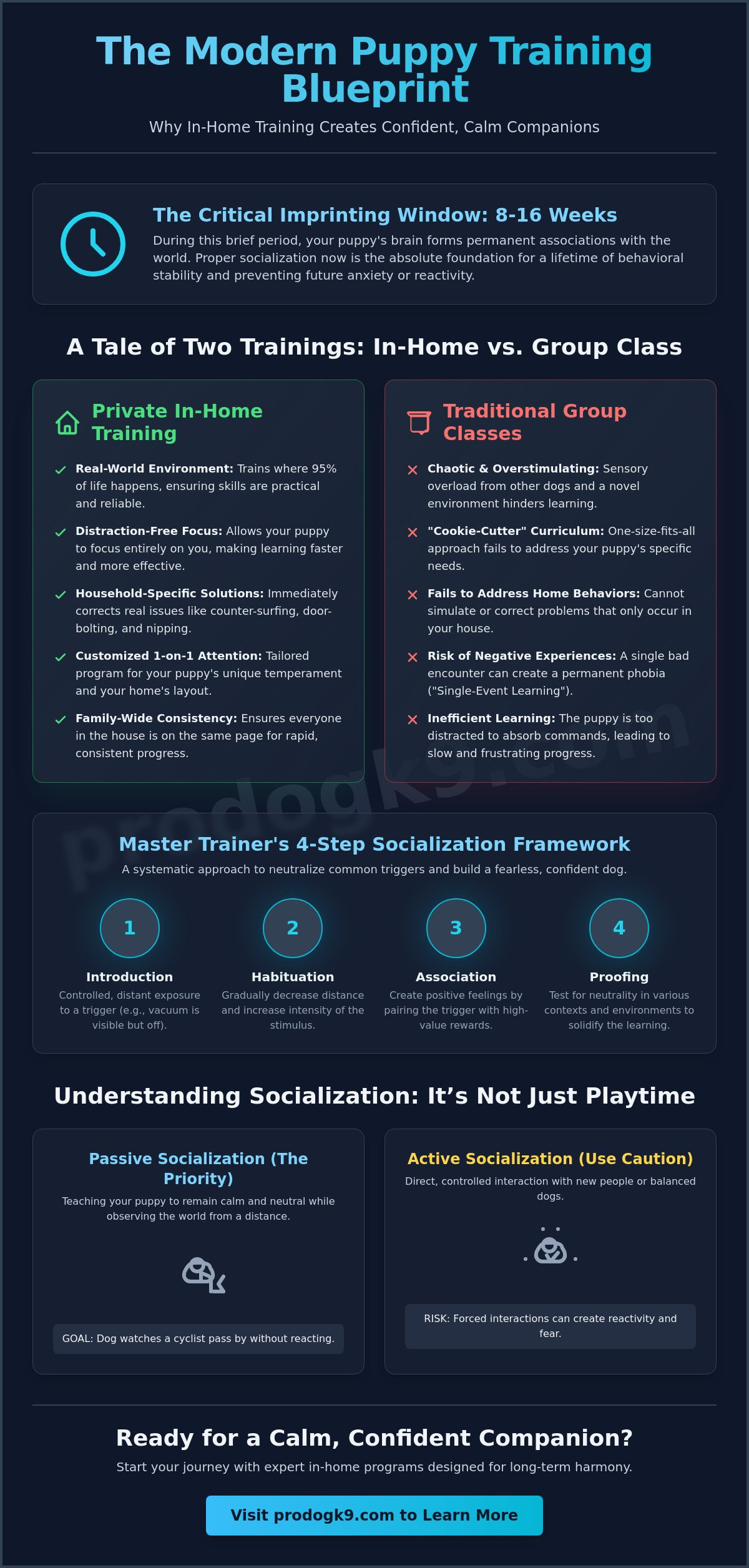
The Master Trainer’s 4-Step Socialization Framework
Effective socialization requires a structured, step-by-step approach that moves from the safety of your living room to the complexity of the outside world. We don't throw puppies into the deep end. Instead, our in-home puppy training Monmouth County programs follow a proven sequence designed to build resilience without causing fear. The American Veterinary Medical Association emphasizes that early behavioral intervention is critical for a dog's long-term well-being. By following this framework, you ensure your puppy views the world as a neutral, safe place.
Step 1: Household Neutrality. Mastery begins where your puppy sleeps. We desensitize your dog to high-frequency triggers like vacuums, doorbells, and kitchen appliances. This prevents the startling reflex that often leads to adult noise phobias.
Step 2: Surface and Tactile Variety. Your puppy must feel confident underfoot. We guide them across grass, gravel, hardwood, and the specific texture of NJ sidewalk pavement. Confidence on different surfaces translates to confidence in new environments.
Step 3: Controlled Outdoor Observation. We move to the driveway or a quiet local park. The goal is observation, not interaction. Your dog learns to watch cars, cyclists, and pedestrians from a safe distance without reacting.
Step 4: Social Neutrality. We teach your dog to ignore passersby and other animals. A dog that lunges to "say hi" is a dog out of control. We aim for a companion that looks to you for direction regardless of who walks by.
Integrating Early Obedience with Socialization
Commands like "sit" and "stay" are more than just tricks; they are essential socialization tools. They give your puppy a "job" to do when they encounter something new or potentially frightening. By focusing on a task, the puppy remains grounded and looks to you as the leader. For a deeper dive into these foundational skills, explore our guide on Puppy Training 101. This integration ensures that your dog isn't just exposed to the world, but is actively listening to you within it. Beyond behavioral guidance, ensuring your pet is physically healthy through expert providers like Animal Hospital of Sullivan County provides the necessary foundation for all future learning.
Safety and Containment During Socialization
Communication is the primary purpose of a leash during these early stages. It shouldn't be used just for restraint, but as a subtle way to guide your puppy's focus back to you. As your puppy grows, establishing clear physical boundaries and providing the right environment becomes equally important. To find tools that help manage your pet's space and well-being, you can visit MyCartGoods.com to explore innovative pet technology and high-quality comfort products. Setting these boundaries early prevents wandering and reinforces the idea that you define where the puppy is allowed to go.
Ready to start your puppy on the right path? Contact us today to schedule your first in-home session and build a foundation that lasts a lifetime.
Starting Your Journey with Pro-Dog K9 Academy’s Expert In-Home Programs
Pro-Dog K9 Academy brings over 30 years of industry leadership directly to your doorstep. We don't just offer a service; we provide a philosophy of mutual respect and clear communication. Our leadership possesses decades of hands-on experience in behavioral modification, ensuring that your in-home puppy training Monmouth County program is built on a foundation of proven results. We understand the unique frustrations of NJ families dealing with domestic chaos. Our goal is to move you from a state of stress to one of disciplined companionship as quickly as possible, a mission shared by professional care providers like Tails On Trails Pet Resort.
The journey doesn't end once your puppy grows out of the nipping phase. We specialize in the seamless transition from foundational puppy classes to advanced adult obedience and, when necessary, aggression rehabilitation. This long-term approach ensures that the habits formed during the critical imprinting window are reinforced as your dog matures. Consistency between the trainer, the owner, and the animal is the only way to achieve lasting success. We act as your seasoned mentors, teaching you how to maintain leadership so your dog remains a reliable member of the family for life; this holistic approach to care is also championed by international experts like H&H Dog.
What to Expect in Your First In-Home Session
Your first session serves as a comprehensive professional evaluation. We begin with a deep assessment of your puppy’s temperament and a clear discussion of your specific household goals. You'll receive immediate, actionable tips to stop unwanted behaviors like jumping, nipping, or furniture destruction. We don't believe in waiting for results. You will see a tangible shift in your puppy's focus before we leave your home. It's time to reclaim your living space from the whirlwind of puppy energy. To find the right gear for your pet's needs, you can discover Panda Cows for a wide range of premium pet accessories.
Long-Term Support for NJ Dog Owners
We provide a clear roadmap for your dog's future development. For families seeking total off-leash reliability, we offer specialized programs like Dogtra collar training to master remote communication. This level of control is control for the active Jersey Shore lifestyle. To ensure you're making the right choice for your family, we encourage you to review our private puppy training checklist. This resource helps you vet providers and understand the high standards required for expert-led behavioral instruction in Monmouth County. For those who travel or seek similar premium care standards abroad, you can visit The Fur Seasons to see how professional pet services are managed in the Sotogrande region.
Build a Lifetime of Confidence and Control
Your puppy's early experiences define the dog they will become. By prioritizing structured socialization and neutrality over chaotic play, you set the stage for a well-mannered companion. High-quality in-home puppy training Monmouth County ensures these lessons take hold in the specific environment where your dog spends the most time. You don't have to navigate the stress of nipping, biting, or fear-based behaviors alone. Our methods transform domestic tension into a disciplined, rewarding bond that lasts for years.
Since 1990, we've served families across Monmouth, Ocean, and Mercer Counties with over 30 years of professional experience. Our deep expertise in behavior modification and aggression rehabilitation allows us to identify and stop potential issues before they become permanent habits. We provide the clear, actionable roadmap you need to lead your puppy with confidence and clarity. It's time to reclaim your home and start your journey toward a calm, reliable companion.
Building this level of confidence and discipline is a lifelong pursuit that extends beyond pet ownership; for those looking to develop their own personal focus and self-defense skills, Sin City Krav Maga & Fitness offers expert-led training designed to empower individuals in any environment.
Schedule Your In-Home Puppy Evaluation with a Master Trainer Today
We look forward to helping you build a foundation of mutual respect and lifelong harmony with your new puppy.
Frequently Asked Questions
Is in-home puppy training more effective than group socialization classes?
In-home training is significantly more effective because it targets behaviors in the specific environment where your puppy spends nearly all of their time. Group classes are often too distracting for foundational learning, leading to overstimulation rather than education. By choosing in-home puppy training Monmouth County families can focus on correcting household-specific issues like nipping, jumping, and door-bolting in real-time. This setting allows for total focus and a much faster progression toward a well-mannered companion. To extend these principles of discipline and focus to the younger members of your family, you can explore Kids Martial Arts for programs that build confidence and respect in a structured environment.
At what age should I start puppy socialization classes in NJ?
You should begin professional socialization as early as 8 weeks old to capitalize on the critical imprinting window. This developmental phase typically begins to close by 16 weeks, making early exposure to varied sounds, surfaces, and environments essential for long-term behavioral stability. Starting early ensures your dog forms neutral, confident associations with the world before fear responses become ingrained. Delaying this process often leads to avoidable anxiety and reactivity as the dog matures.
This early stage is also the ideal time to establish a relationship with a veterinarian to ensure your pet's physical development matches their behavioral progress; for those seeking expert medical care, check out Animal Hospital of Sullivan County.
Can my puppy be socialized before they have all their vaccinations?
Yes, and major veterinary organizations recommend early socialization to prevent the development of permanent behavioral phobias. While you should avoid high-traffic public areas like dog parks until vaccinations are complete, your home and yard are safe, controlled environments for early learning. We focus on habituating your puppy to new stimuli within their comfort zone. This approach balances physical safety with the urgent need for behavioral development, ensuring a well-adjusted adult dog. For families who may eventually require professional care, facilities like Tails On Trails Pet Resort provide a structured environment that aligns with these early training principles.
How much does in-home puppy training cost in Monmouth County?
Professional training costs vary depending on your puppy’s temperament and your specific behavioral goals. We provide customized quotes after a professional evaluation of your household needs and the puppy's current progress. Investing in expert-led instruction during the early months is the most efficient way to prevent expensive behavioral issues later in life. Contact us directly to discuss a program tailored to your family's schedule and requirements.
What happens if my puppy is already showing signs of fear or aggression?
Address these red flags immediately with professional Aggression Rehabilitation before they become permanent personality traits. Growling, snapping, or extreme hiding are signals that your puppy lacks confidence or clear leadership. We specialize in identifying the root cause of these behaviors and implementing corrective measures to redirect the animal. Early intervention by a Master Trainer is the only reliable way to move from domestic tension to a state of disciplined companionship. Furthermore, it is always wise to consult with a veterinarian in Sullivan County to rule out any underlying medical conditions that might be influencing your pet's temperament.


Comments