


How to Find a Break in an Invisible Fence Wire in NJ: The Master Trainer's Guide
You're standing in your kitchen, and that relentless, high-pitched beeping from the transmitter is echoing through the house. It's more than just an annoying sound; it's the sound of your dog's safety net failing. You know your pet is at risk of wandering into a busy street, but the thought of trenching your entire manicured lawn to find a single wire break feels like a second disaster. Learning how to find a break in an invisible fence wire NJ doesn't have to mean destroying your property or spending hours on your hands and knees.
We understand the frustration of a broken system and the urgent need to restore your peace of mind. This master trainer's guide provides the exact professional techniques used to pinpoint wire damage with surgical precision. You'll learn how to isolate the problem area without digging up your yard. We'll walk through the essential diagnostic tools, the "short-loop" test to verify transmitter health, and the step-by-step process to locate the break using professional-grade equipment. This guide ensures you can fix the issue quickly and get your dog back to safety today.
Key Takeaways
Master the "Short Loop Test" to immediately determine if your signal loss is caused by a faulty transmitter or a physical break in the ground.
Discover exactly how to find a break in an invisible fence wire NJ using professional-grade RF locators or effective DIY radio techniques.
Identify how unique New Jersey environmental factors, such as frost heave and sandy soil shifts, specifically impact the longevity of your containment system.
Learn the technical requirements for high-conductivity splices to prevent high resistance from damaging your transmitter over time.
Execute essential re-training steps to ensure your dog respects the restored boundary and eliminates the dangerous "dead zone" habit.
Table of Contents
Diagnosing the Signal Loss: Is Your Invisible Fence Wire Actually Broken?
The sudden, rhythmic chirping of your transmitter is a call to action. Before you start searching for how to find a break in an invisible fence wire NJ, you must confirm that the wire is actually the problem. Most electronic pet containment systems feature an audible alarm that triggers when the electrical loop is interrupted. If your transmitter is beeping, it's sensing a break. However, if the unit is completely dark and silent, you're likely looking at a power failure rather than a severed wire. Check your outlet and the lightning surge protector first. New Jersey summer storms are notorious for frying these protectors, which can mimic the symptoms of a system failure without a single inch of wire being damaged.
Begin your investigation at the exit point. This is where the twisted wire leaves your basement or garage and enters the soil. Because this wire often sits near the surface, it's highly susceptible to damage from string trimmers or heavy foot traffic. If the exit point looks secure, it's time to move to a more technical diagnosis to ensure the transmitter's internal circuitry isn't the real culprit.
To better understand the diagnostic process, watch this helpful video:
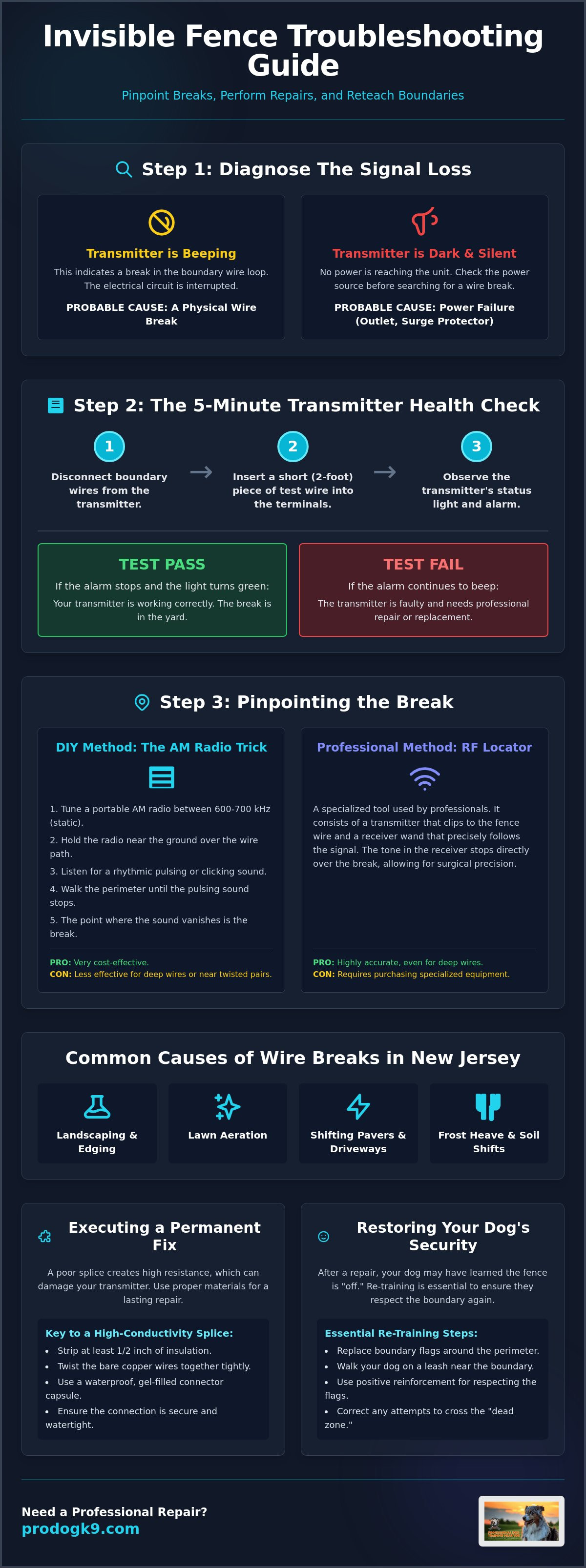
The 5-Minute Transmitter Loop Test
Perform a "short loop test" to isolate the issue. Disconnect the two boundary wire ends from your transmitter. Take a spare two-foot piece of insulated copper wire and strip half an inch of insulation off both ends. Insert these ends into the transmitter terminals to create a mini-loop. If the beeping stops and the light turns green, your transmitter is healthy, and the break is definitely in your yard. If the alarm continues, the transmitter's internal fuse or board is likely blown. In this case, you'll need Invisible Fence Repair services to replace the unit rather than hunting for a non-existent wire break.
Inspecting Common 'Weak Points' in NJ Yards
Once you've confirmed a yard break, focus your visual search on high-risk zones. Landscaping projects are the primary cause of wire failure in Monmouth and Ocean Counties. Walk the perimeter and look for fresh mulch, new plantings, or recently edged garden beds. If you've had your lawn aerated or "slice seeded" recently, these machines often snag wires buried less than three inches deep. Pay close attention to where the wire crosses driveways or sidewalks; shifting pavers can easily pinch or sever the line over time. Identifying these "weak points" is the fastest way to master how to find a break in an invisible fence wire NJ without specialized equipment.
How to Find a Break in an Invisible Fence Wire: DIY Locating Techniques
Locating a gap in your underground boundary doesn't require luck; it requires a systematic search. Once you've confirmed the transmitter is functional, you need to track the signal until it vanishes. Learning how to find a break in an invisible fence wire NJ allows you to preserve your landscaping while restoring your dog's safety. You have two primary DIY options: the classic radio trick or a specialized RF locator kit. Both methods rely on your ability to hear the electrical pulse traveling through the copper line.
The AM Radio Trick Step-by-Step
Grab a portable, battery-powered AM radio. Tune it to the lowest end of the dial, typically between 600 and 700 kHz, where you can hear static rather than a broadcast station. You're listening for a clear, rhythmic "clicking" or "pulsing" sound that matches the cadence of your fence transmitter. Hold the radio close to the ground and walk the known perimeter of your fence. Swing the radio in a slow, side-to-side motion over the wire's path to detect where the signal drops off or disappears entirely. This method is cost-effective, but it often struggles with deep-buried wires or twisted pair sections where the signals cancel each other out. It's also highly sensitive to external interference from overhead power lines, which can mask the fence's pulse.
Using a Professional-Grade Wire Break Locator
For more reliable results, utilize a dedicated wire break locator kit. These devices consist of an independent transmitter and a handheld receiver wand. Safety is paramount; always unplug your fence transmitter from the wall before connecting any locator tools to the boundary wire. Attach the locator's transmitter to your wire to send a high-frequency RF signal through the loop. As you walk the line, the receiver will provide a "peak" signal directly over the wire or a "null" dead spot, depending on the model. This precision is essential for anyone researching how to find a break in an invisible fence wire NJ, as it helps you avoid digging up the wrong sections of your property.
Be mindful of your environment during the search. Buried metal pipes, high-voltage utility lines, or even specific New Jersey soil properties like high mineral content in certain Monmouth County pockets can create interference. These factors often generate false positives that lead to unnecessary frustration. If the signal remains elusive, use the "sectioning" strategy. Cut the wire at a halfway point and use a temporary jumper wire to create a smaller, functional loop. If the transmitter stops beeping, you've confirmed the break is in the other half of the yard. Repeat this process to narrow the search area to a manageable 20-foot stretch. If the DIY process becomes too complex, our team provides expert Invisible Fence Repair to restore your system with professional-grade diagnostics.
NJ Geographic Challenges: Why Your Fence Wire Breaks in Monmouth and Ocean Counties
Locating a gap in your containment system isn't just about the tools you use; it's about understanding the New Jersey terrain. Our state's unique geography plays a massive role in why these systems fail. If you're wondering how to find a break in an invisible fence wire NJ, start by looking at your local environment. Monmouth and Ocean Counties present specific challenges that homeowners in other regions rarely face. From the shifting sands of the Jersey Shore to the heavy clay pockets further inland, the ground beneath your feet is constantly in motion. This movement is the primary driver of wire fatigue and eventual breakage.
Soil composition varies wildly across the Garden State. In Ocean County, the sandy soil allows for significant wire shifting. Sandy ground doesn't hold its shape well, meaning heavy rains or even simple root growth can push a wire out of its original trench. Contrast this with Mercer County's clay-heavy soil. Clay holds the wire firmly but is prone to deep cracking during summer droughts. These cracks can actually snap a brittle wire as the earth pulls apart. Additionally, our state's dedication to curb appeal is a major factor. Professional edging is a staple of NJ lawn care, but a sharp power edger is the natural enemy of a buried wire. Most breaks in Monmouth County happen right at the transition between the grass and a garden bed where landscaping tools strike with precision.
Frost Heave and the NJ Winter Cycle
New Jersey winters are characterized by frequent freeze-thaw cycles. When water in the soil freezes, it forms ice lenses that expand and physically lift anything in their path. This process, known as frost heave, slowly migrates your boundary wire toward the surface over several seasons. By the time spring arrives, the wire often sits high enough for a lawnmower blade to snag it. This is why spring is the peak season for residents searching for how to find a break in an invisible fence wire NJ. To combat this, ensure your wire is buried at least 3 to 5 inches deep, which is the standard for the Mid-Atlantic climate.
Coastal Corrosion Near the Jersey Shore
If you live within a few miles of the Atlantic, salt air is a silent enemy. Salt-laden moisture is highly corrosive and penetrates standard electrical tape or poor-quality wire nuts with ease. Once moisture enters a splice, it triggers "corrosion creep." This means the copper inside the insulation begins to rot and turn brittle several feet away from the original break. Always use DBY or DBR waterproof connectors for any Invisible Fence Repair. These gel-filled capsules seal out the salt air entirely. If you find a break and the wire looks black or green instead of shiny orange, you must cut back until you find clean copper to ensure a lasting fix.
Professional Repair vs. DIY: Ensuring a Permanent Fix
DIY methods like the AM radio trick are useful for a quick search, but they often fall short of providing a permanent solution. While you might learn how to find a break in an invisible fence wire NJ on your own, the actual repair is where most systems fail again within months. A common mistake is using standard electrical tape or simple wire nuts. These materials are not waterproof. Moisture eventually seeps into the connection, causing high resistance. This resistance doesn't just stop the signal; it forces your transmitter to work harder, eventually burning out the internal circuitry. Replacing a fried transmitter is far more expensive than a professional repair.
A professional fix addresses the root cause of the failure. We don't just patch the wire; we restore the electrical integrity of the entire loop. This ensures that the signal remains crisp and consistent, providing the clear communication your dog needs to stay safe. If you find yourself struggling with a recurring alarm, it's time to stop guessing and seek a definitive resolution.
The Anatomy of a Professional Splice
We prioritize longevity over speed. Every repair we perform uses silicone-filled capsules and heat-shrink tubing to create a hermetic seal against the elements. This is critical in the damp New Jersey soil. Once the splice is secure, we test the continuity and signal strength across the entire loop. We don't just fix the break; we verify the integrity of the system. In many cases, a professional visit is more cost-effective than purchasing a high-end locator kit that will sit in your garage for years. We ensure the connection is stronger than the original wire itself.
When DIY Troubleshooting Fails
Sometimes the wire isn't fully severed. These are called "ghost breaks" or partial breaks, where the copper is intact but the insulation has failed. This allows the signal to leak into the earth, creating a weak or inconsistent boundary that confuses your dog. Standard DIY tools can't find these. We use professional Time Domain Reflectometer (TDR) equipment to send a pulse down the line and measure exactly how many feet away the fault occurs. If your system is old or riddled with past DIY patches, it might be time to consider a full Invisible Fence Installation NJ to ensure total reliability.
A Master Trainer brings more than just tools; they bring an understanding of animal behavior. When we arrive for a repair, we inspect the entire perimeter for potential future failure points. We also check the collar's activation and the dog's response to the boundary. If you've spent hours trying to figure out how to find a break in an invisible fence wire NJ without success, don't risk your dog's safety on a guess. Search for invisible fence repair near me to get the job done right the first time. Secure your home and your pet's freedom by contacting us for professional Invisible Fence Repair today.
Restoring Your Dog's Security: Re-Training After a Repair
Fixing the physical copper line is only half the battle. While you've successfully mastered how to find a break in an invisible fence wire NJ and completed the repair, your dog's perception of the boundary has likely shifted. When a system fails, it creates a "dead zone" where the warning beep disappears. Dogs are incredibly observant; if they've spent even a few hours realizing the boundary no longer has consequences, they lose respect for the perimeter. This "boundary-bold" behavior can lead to future escapes even after the signal is restored. You must bridge the gap between a functional wire and a disciplined pet to ensure total safety.
Restoring security requires a deliberate transition back to a controlled environment. Don't assume your dog will remember the rules the moment the transmitter stops beeping. Use this time to refine your communication and reinforce the bond of mutual respect. For owners utilizing remote trainers alongside their fence, our Dogtra collar training guide offers advanced insights into maintaining consistent communication during these transition periods.
Testing the Correction Post-Repair
Before putting the collar back on your dog, verify the signal consistency at the repair site. Use the test light tool included with your system to check that the collar activates at the correct distance from the wire. Walk the entire perimeter slowly. You're looking for signal "wobble," which is an inconsistent activation zone often caused by poor-quality splices or interference. If the collar activates significantly closer to the wire at the repair spot than elsewhere, adjust the transmitter range to match your original installation specs. A uniform signal is the foundation of effective containment.
Re-Establishing Boundary Trust
Execute a condensed 3-day refresher protocol to remind your dog that the "beep" is back. Some dogs become "boundary-shy" after a repair, refusing to go into the yard at all, while others will immediately try to test the previously broken section. Follow this structured approach:
Day 1: Re-install white flags at the repair site. Lead your dog to the area on a long leash and allow them to hear the warning beep. Immediately retreat to the safe zone and offer high-value praise.
Day 2: Introduce mild distractions, like a favorite toy, near the restored boundary while keeping the dog on a leash. Reinforce the "turn and retreat" behavior.
Day 3: Supervise off-leash time closely. Watch for any hesitation or attempts to push the limit at the old break location.
If your dog has developed a habit of ignoring the boundary during the outage, professional intervention may be necessary to correct the behavior safely. Contact Pro-Dog K9 Academy for expert help with boundary re-training and aggression rehabilitation. We ensure your pet understands the limits of their freedom, moving your household from a state of worry back to disciplined companionship. Now that you know how to find a break in an invisible fence wire NJ and how to restore the training, your yard is once again a secure sanctuary.
Secure Your Yard and Restore Your Peace of Mind Today
A broken boundary is more than a technical glitch; it's a gap in your dog's safety net. By now, you understand that successful containment relies on accurate diagnosis and a deep appreciation for the unique environmental challenges of the Garden State. Whether you're battling frost heave in Monmouth or shifting sands in Ocean County, learning how to find a break in an invisible fence wire NJ is the first step toward reclaiming your pet's security. Remember that the physical repair is only complete once you've re-verified the signal and reinforced boundary respect through consistent training.
Don't let a "dead zone" turn into a dangerous habit for your pet. With over 30 years of Master Trainer experience and specialized professional locating equipment, we provide permanent solutions that DIY methods often miss. We proudly serve families across Monmouth, Ocean, Burlington, and Mercer Counties. If you're ready for a surgical fix that preserves your lawn and protects your dog, Schedule a Professional Invisible Fence Repair with Pro-Dog K9 Academy. Take the lead today and return your household to a state of disciplined companionship. Your dog's safety is worth the expert touch.
Frequently Asked Questions
How do I know if my invisible fence wire is broken?
Listen for the audible alarm on your wall-mounted transmitter. Most professional systems emit a continuous beep or a rhythmic chirping sound when the electrical loop is interrupted. If the transmitter has power but the "loop" light is red or blinking, you have a physical break in the yard. Check your surge protector first; if the protector is fried, the system will appear dead even if the wire is intact.
Can I find a wire break without a specialized locator kit?
You can use a portable AM radio tuned to a blank frequency around 600 kHz. Walk the perimeter while holding the radio close to the ground to listen for the transmitter's pulsing "click." When the clicking stops, you've likely found the fault. While this is a common way to learn how to find a break in an invisible fence wire NJ, it lacks the precision of professional RF equipment and often fails near utility lines.
How deep should an invisible fence wire be buried in NJ?
Bury your boundary wire at a depth of 3 to 5 inches to withstand the Mid-Atlantic climate. New Jersey's frequent freeze-thaw cycles cause a phenomenon called frost heave, which physically pushes shallow wires toward the surface. Maintaining this specific depth protects the copper from lawnmower blades, aerators, and power edgers. If you live in a sandy coastal area, consider burying the wire slightly deeper to prevent shifting.
Will a wire break locator find a break under a driveway?
Professional-grade locators can often track a signal through several inches of asphalt or concrete. However, the signal strength will be significantly weaker than it is in open soil. If the wire was installed correctly inside a protective conduit, the break is rarely under the driveway itself. Most failures occur at the expansion joints or the transition points where the wire enters and exits the hardscape.
Is it safe to splice my own invisible fence wire?
Splicing the wire is safe for the homeowner, but an improper connection is a major risk to your equipment. Never use standard wire nuts or electrical tape for underground repairs. These allow moisture to corrode the copper, creating high electrical resistance that can eventually burn out your transmitter's circuitry. Use only gel-filled, waterproof splice kits to maintain the electrical integrity of the loop and ensure a permanent fix.
How much does a professional invisible fence repair cost in NJ?
The cost of a professional repair depends on the number of breaks and the diagnostic time required. While do-it-yourself materials are cheap, they often lead to recurring failures and confused pets. Investing in a professional repair provides you with high-conductivity splices and a full system calibration. This prevents the need for future service calls and ensures your dog’s containment system remains reliable year-round.
Why does my fence keep beeping even though I fixed the break?
Your system likely has multiple breaks or a "ghost break" where the wire is partially damaged but not fully severed. It is common for a single landscaping incident to snag the wire in two or three nearby locations. If the alarm persists after your first repair, you must continue the search using the sectioning strategy. Don't overlook the possibility of a corroded splice from a previous DIY attempt elsewhere in the yard.
Do I need to re-train my dog after the fence is repaired?
Execute a 3-day refresher protocol to restore your dog's respect for the boundary. Dogs are opportunistic; if they discovered the fence was "dead" during the outage, they will likely test the limits again. Re-install training flags at the repair site and lead your dog through the "beep-and-retreat" drill. This simple step eliminates the dangerous "boundary-bold" behavior that often develops after a system failure.


Comments