


E-Collar Training for Recall: The Master Trainer’s Guide to Off-Leash Reliability (2026)
Updated: Jun 12
What if you could drop the leash in a crowded New Jersey park and know, with absolute certainty, that your dog will return the moment you call? For most owners, the dream of off-leash freedom is clouded by the fear of a dog darting toward traffic or the embarrassment of being ignored in front of neighbors. You want to provide a life of liberty for your dog, but the anxiety of using a tool incorrectly often holds you back. Mastering e-collar training for recall isn't about using a "shock" as punishment. It is about establishing a sophisticated invisible leash through clear, low-level communication that your dog understands instantly.
We recognize the frustration of domestic chaos and the desire for a disciplined, safe companion. You deserve the confidence that comes with professional-grade reliability. This guide provides the master trainer's blueprint for ensuring your dog returns every single time, regardless of squirrels, cyclists, or local distractions. To help you select the ideal tools for this journey, you can discover Educator Collars and their range of advanced training systems. We will explore how to use modern Dogtra technology to bridge the communication gap, moving from a state of worry to a deeper bond built on mutual respect and total off-leash control.
Key Takeaways
Understand why traditional recall fails when environmental distractions outweigh rewards and how to reframe the e-collar as a high-tech communication tool.
Master the precise setup of the Dogtra 1900S to identify your dog's subtle "Working Level" for effective e-collar training for recall.
Bridge the gap between physical leashes and remote freedom using a professional 4-step process that layers low-level stimulation with long-line control.
Apply the "Pressure-Off" principle to teach your dog that returning to you is the fastest way to achieve comfort and clarity.
Execute a "Graduation Test" against real-world New Jersey distractions to ensure 10/10 reliability before you ever unclip the leash.
Table of Contents
The Foundation of Reliable E-Collar Recall
Reliable recall is the ultimate goal for every responsible dog owner. However, traditional training often hits a wall when a squirrel darts across a lawn in Monmouth County. This is the valuation problem. Your dog weighs the value of your treat against the thrill of the chase. If the chase wins, the recall fails. Effective e-collar training for recall solves this by transforming the device into a high-tech extension of a physical leash. To understand the technology, one might ask what is an e-collar and how it functions as a communication tool rather than a punishment. We view it as a remote touch. It provides a clear, unmistakable signal that cuts through the noise of environmental distractions.
Before you touch the remote, you must follow the Master Trainer rule: Your dog must already understand the "come" command on a standard leash. Electronics do not teach the command; they reinforce it at a distance. Our goal is 100% reliability. We want your dog to respond with the same urgency in your backyard as they do when facing the heavy distractions of a busy NJ neighborhood. This foundation ensures safety and builds a bond based on clear, consistent expectations. To find the right system for your needs, you can explore ET-300 Mini Educator and other professional-grade options.
Why the E-Collar is an 'Invisible Leash'
Think of the e-collar as a remote tactile cue. It mirrors the physical sensation of a gentle tug on a long line. This "tap" provides clarity when your dog is fifty yards away. In residential areas across Mercer and Monmouth County, this invisible leash is a literal lifesaver. It allows your dog to explore while you maintain the ability to "reach out" and guide them back instantly if a car approaches or a gate is left open.
Prerequisites for Recall Success
Before you begin, it is vital to have the correct equipment; EducatorCollars.com offers a wide range of professional remote training systems and accessories to help you achieve success.
Success begins with a baseline of obedience. Verify that your dog responds to basic cues inside the home where distractions are low. Once they are consistent indoors, introduce the long line. This thirty-foot lead acts as an essential safety net during the transition to e-collar training for recall. It prevents the dog from practicing "the ignore" while you begin layering in remote communication. Never rush this phase. A solid foundation on the line leads to total freedom off it.
Setting Up Your Dogtra E-Collar for Success
Precision begins with the right equipment. We recommend the Dogtra 1900S as the industry standard for professional-grade reliability. This unit offers a wide range of stimulation levels, allowing for the micro-adjustments necessary for successful e-collar training for recall. Unlike cheaper alternatives, this model ensures that the signal is consistent every time you press the button. This consistency is vital because your dog relies on clear communication to understand what is expected. Scientific research on e-collar effectiveness highlights that when tools are used with professional protocols, they provide clear feedback that facilitates learning without causing undue stress.
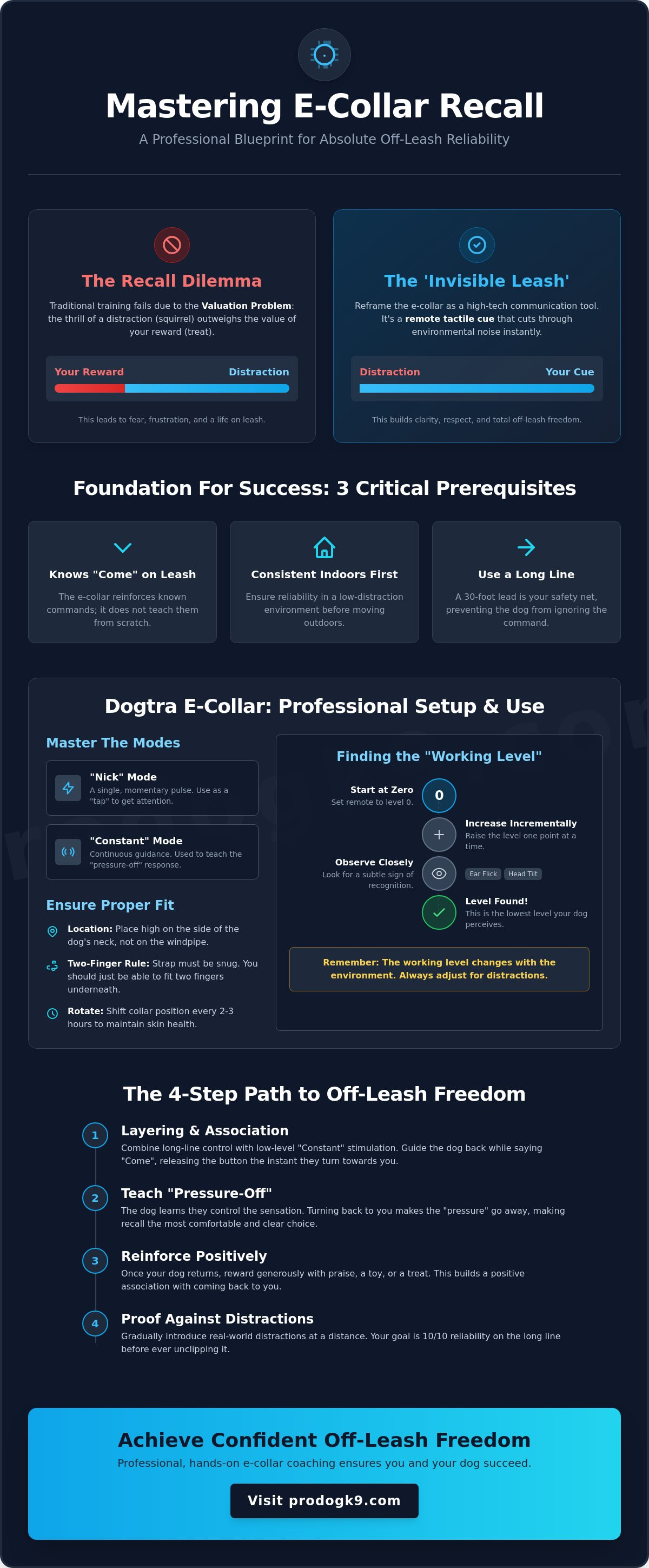
Mastering the settings is your first task. You must distinguish between "Nick" and "Constant" modes. The "Nick" setting delivers a single, momentary pulse lasting a fraction of a second. It acts like a physical "tap" on the shoulder to get your dog's attention. In contrast, "Constant" stimulation provides a continuous signal as long as the button is held. During initial recall training, the "Constant" mode is used to provide guidance. It creates a "pressure-on" sensation that only stops when the dog turns toward you, teaching them how to control the signal through their own behavior.
Finding the 'Working Level' Step-by-Step
Identify your dog's unique sensitivity before you begin training. Start with the remote set to zero and fit the collar properly. Increase the level incrementally, one point at a time, while observing your dog closely for a "recognition" sign such as an ear flick, a head tilt, or a subtle change in expression. The 'Working Level' is the lowest point of communication that ensures your dog's focus without causing any signs of distress or vocalization. This level will fluctuate. A setting that works in your quiet living room will likely be too low for a busy New Jersey park filled with joggers and other dogs. Always adjust for the environment to maintain clarity.
Proper Collar Fit and Maintenance
Placement is just as important as the setting. Ensure the contact points are snug against the skin on the side of the dog's neck. Use the "two-finger" rule: you should be able to slide two fingers under the strap, but the collar shouldn't rotate freely. To maintain skin health, rotate the collar position every two to three hours. This prevents pressure sores and ensures the signal remains consistent. If you need hands-on help with your setup, our at-home Dogtra e-collar coaching can get you started on the right foot.
The 4-Step E-Collar Recall Training Process
Effective e-collar training for recall is a systematic progression. You cannot simply put the collar on and expect instant results. Instead, we use a layered approach that bridges the gap between physical control and remote reliability. This process relies on the "Pressure-Off" principle. By teaching your dog that returning to you stops the low-level stimulation, you create a clear path to success. While some veterinary guidance on e-collars emphasizes the high value of positive reinforcement, we integrate rewards into every step. We want a dog that returns with enthusiasm, not one that acts out of fear. The stimulation is simply the cue; the reward is the motivation.
Step 1 & 2: The Long Line Bridge
Phase one begins by layering the electronic signal over the physical guidance of a long line. When you give the "come" command, you apply low-level constant stimulation and simultaneously use the long line to guide the dog toward you. The moment the dog commits to the turn, you stop the stimulation and provide heavy praise. This "turn and burn" response is the foundation of the entire system. It teaches the dog that they have the power to turn the sensation off by moving in your direction. This phase removes all ambiguity and prevents the dog from making mistakes while they are still learning the new language of Dogtra collar training.
Step 3 & 4: Proofing and Generalization
Once your dog is consistent in your NJ backyard, it is time to generalize the behavior. Move to the driveway, then eventually to local Monmouth or Ocean County parks. You must introduce "controlled" distractions, such as a family member walking nearby or a tossed toy. If your dog misses a command, don't increase your frustration. Stay calm. Use the long line to guide them back and repeat the rep at a slightly lower distraction level. Reliability is built through successful repetitions, not through escalating conflict. If you find yourself struggling with these transitions, our at-home obedience training can provide the professional oversight needed to ensure your dog remains focused in any environment.
Phase 1: Layering stimulation with the long line for physical clarity.
Phase 2: Applying the 'Pressure-Off' principle to reward the return.
Phase 3: High-repetition work in low-distraction, controlled environments.
Phase 4: Gradual exposure to real-world NJ distractions to cement reliability.
Proofing Recall in Your NJ Neighborhood
Proofing is the final hurdle. While your backyard provides a controlled environment, the real world is filled with high-arousal triggers. In New Jersey, this means white-tailed deer, darting squirrels, passing traffic, and other leashed dogs on the sidewalk. Successful e-collar training for recall requires you to test your dog's reliability against these specific distractions before you ever consider unclipping the leash. You must move from the vacuum of a quiet yard to the complexity of your local suburban streets.
Execute the "Graduation Test" to confirm mastery. Your dog must achieve 10 out of 10 successful recalls while trailing a long line in a public area. The line stays on the ground, acting as a handle you can grab if needed, but the dog should feel completely free. If they fail even once, they aren't ready for total liberty. DIY mistakes often happen here because owners rush the process or fail to calibrate the remote settings properly. Consulting a Dogtra e-collar specialist ensures your timing and levels are precise, preventing the confusion that leads to a blown command. Always prioritize safety and adhere to local NJ leash laws in public parks until you have verified absolute reliability.
Real-World Troubleshooting
High-arousal moments can cause even a trained dog to "blow off" the collar. If your dog ignores the tap because they are focused on a squirrel, don't panic. Stay calm and use the trailing long line to reinforce the command immediately. You must also maintain the value of the return. The e-collar provides the cue, but high-value rewards like steak, liver, or a favorite toy keep the training positive and enthusiastic. Never let the recall become a "game over" for your dog's fun.
When to Call a Professional Master Trainer
Some situations require more than a guide. If you are working with a high-drive hunting breed or a dog with a history of aggression, the stakes are much higher. DIY attempts with these temperaments can lead to unintended behavioral fallout. Pro-Dog K9 Academy specializes in tailoring e-collar programs specifically for NJ families. We move your dog from domestic chaos to disciplined companionship through specialized at-home obedience training. We ensure your "invisible leash" is a tool of connection, not conflict.
Master the Invisible Leash for Lasting Reliability
You now possess the blueprint for a reliable return. By mastering the Dogtra 1900S and applying the "Pressure-Off" principle, you've moved beyond the limitations of a physical leash. You understand that e-collar training for recall is about clear, tactile communication that cuts through the noise of NJ wildlife and suburban distractions. This foundation transforms your relationship from one of domestic chaos to one of disciplined companionship based on mutual respect and clarity. It's time to stop worrying and start enjoying your walks again.
A disciplined dog is a joy to include in your family's most important milestones, from weddings to mitzvahs. For those in the Middletown area looking to capture these memories, Delgado Studios provides expert event photography that celebrates your family's unique bond.
Don't leave your dog's safety to chance or trial and error. Our Master Trainer brings over 30 years of deep industry experience to help you navigate this transition with absolute confidence. We provide specialized Dogtra 1900S instructional programs tailored to your dog's unique temperament and your family's lifestyle. We proudly serve dedicated owners throughout Monmouth, Ocean, Burlington, and Mercer Counties. Book a Professional E-Collar Consultation with a Master Trainer Today to begin your journey toward total off-leash freedom. Your dog deserves the liberty to explore, and you deserve the peace of mind that comes with a perfect recall.
Frequently Asked Questions
Is e-collar training for recall considered humane?
E-collar training is humane when used as a low-level communication system rather than a punitive tool. Modern devices utilize TENS technology to deliver a subtle "tap" that is perceptible but not painful. This allows you to guide your dog with absolute clarity from a distance. When paired with high-value rewards, it builds a bond based on mutual understanding. Professional calibration ensures the stimulation stays at a level that avoids any unnecessary stress.
How old should my puppy be before starting e-collar training?
Puppies should generally be at least six months old before beginning remote collar work. Your dog must have a solid grasp of basic obedience commands like "sit" and "come" on a standard leash first. We recommend starting with at-home puppy classes to build these essential foundations. Introducing electronics too early can confuse a young dog that hasn't yet learned how to process formal instruction or handle environmental pressure.
While waiting to start formal remote training, focusing on socialization through a reputable daycare like Tails On Trails Pet Resort can help your puppy build confidence and learn how to interact with others in a controlled, professional environment.
Can I use an e-collar for recall if my dog is aggressive?
You can use an e-collar for recall with aggressive dogs, but you must do so under the direct guidance of a specialist. DIY attempts with reactive animals often lead to redirected aggression or increased fear. Professional aggression rehabilitation programs ensure the tool is used to clarify expectations rather than escalate conflict. This creates a safer environment for both the dog and the community while building reliable off-leash control through clear leadership.
What is the best e-collar for recall training at home?
The Dogtra 1900S is the gold standard for e-collar training for recall at home. It features 127 levels of stimulation, allowing for the micro-adjustments needed to find your dog's unique sensitivity. Its ergonomic design and consistent output make it the reliable choice for New Jersey owners. This model provides the precision required to bridge the gap between a physical leash and total remote freedom without any signal lag.
While the 1900S is a top choice, you can explore a variety of high-performance alternatives at Educator Collars to find the perfect fit for your dog's specific needs.
How long does it take to fully train a dog for off-leash recall?
Most dogs achieve reliable off-leash results within four to six weeks of consistent daily practice. The timeline depends on your dog's drive and how often you proof the behavior against real-world distractions. You'll spend the first few weeks building clarity in low-distraction areas before testing the recall in busy public parks. Total reliability is a marathon, requiring patient repetitions to ensure 10/10 performance every time you give the command.


Comments