


Dogtra Collar Training Guide: Mastering Remote Communication at Home (2026)
Updated: May 26
What if the key to a perfectly behaved dog isn't a louder voice, but a more refined signal? You want the freedom of an off-leash life, yet the fear of causing your dog pain or the frustration of being ignored keeps you tethered to a physical leash. Using a professional Dogtra collar training guide allows you to move past the domestic chaos of inconsistent recall and poor boundary control. It's exhausting to watch your companion ignore a "come" command while they bolt toward the street. You deserve domestic peace, not a daily struggle for control.
This guide will show you how to transform your device from a source of confusion into a humane, high-tech "remote leash" that ensures reliable obedience. We believe in communication over punishment. By calibrating the technology to your dog's unique perception threshold, you'll build a bridge of mutual respect that works every time. We'll walk through the exact steps to achieve a reliable recall and the confidence to use this technology safely. Get ready to replace the stress of inconsistent boundaries with the relief of a calm, disciplined companion who listens without hesitation.
Key Takeaways
Redefine your understanding of e-collars by learning how Dogtra technology functions as a modern communication tool rather than a device for punishment.
Ensure safety and precision by mastering the "Two-Finger Rule" and proper collar placement high on the neck for clear, humane contact.
Follow this Dogtra collar training guide to successfully navigate the "Collar-Wise" phase, ensuring your dog listens even when the unit is powered off.
Eliminate common training setbacks by learning why you must fully teach a command before introducing any electronic stimulation.
Discover how professional at-home obedience training bridges the gap between technical tools and reliable, real-world behavior.
Table of Contents
Understanding Dogtra Technology: Beyond the "Shock Collar" Myth
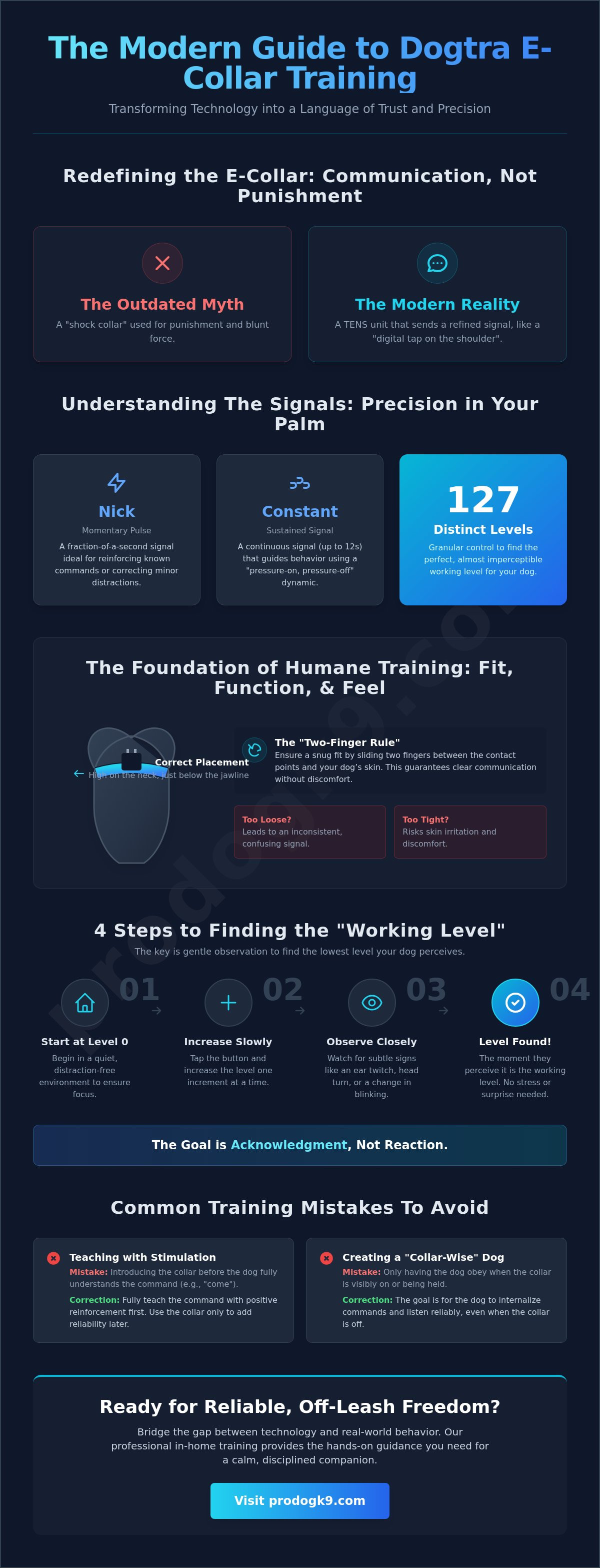
Forget the outdated term "shock collar"; modern technology has replaced blunt force with medical-grade precision. A Dogtra e-collar is essentially a portable TENS unit. It's the same technology used in physical therapy to stimulate human muscles. This Dogtra collar training guide focuses on using these signals as a refined language between you and your dog. Think of it as a digital tap on the shoulder. It captures attention without causing distress. Using this tool correctly moves your household from a state of domestic chaos to one of disciplined companionship.
Clarity starts with understanding the two primary signals: "Nick" and "Constant." A "Nick" is a momentary pulse that lasts a fraction of a second. It's ideal for reinforcing known commands or correcting minor distractions. "Constant" stimulation provides a sustained signal for up to 12 seconds while you hold the button. This isn't meant to overwhelm the dog. Instead, it creates a "pressure-on, pressure-off" dynamic that guides them toward the correct behavior. Understanding E-Collar Technology helps owners realize that these tools are designed for communication, not punishment. When you pair a specific action with a corresponding benefit, the dog learns at an accelerated pace.
The Science of Low-Level Stimulation
Accuracy matters when you're working with a sensitive animal. Dogtra receivers utilize medical-grade hardware to ensure the signal is consistent every time you press the button. With 127 distinct levels of stimulation, you can find the exact "working level" where your dog first perceives the sensation. For most dogs, this feels like a faint cell phone vibration or a mild muscle tingle. This granular control is why Dogtra remains the industry leader for low-level, high-precision training. It allows for specialized behavioral correction without the risk of over-stimulation.
Why Dogtra is Preferred for Home Training
Efficiency is a requirement for busy families. Models like the Dogtra ARC and 1900S feature ergonomic designs that curve around the dog’s neck for a discreet fit. They are fully waterproof. This is essential for handling unpredictable New Jersey weather during backyard sessions. This Dogtra collar training guide emphasizes practicality; many units now offer hands-free features. These allow you to trigger the signal with a small remote button while your hands are full with groceries or a child’s hand. You get immediate control without the chaos of fumbling for a bulky transmitter. For owners interested in exploring other professional-grade hardware, Educator Collars offers a selection of advanced remote training systems and accessories that prioritize these same high standards of durability and ease of use. It's a streamlined approach for real-world environments.
The Foundation of Humane Training: Fit, Function, and Feel
Success with this technology begins with a perfect fit. You cannot achieve reliable results if the receiver slides around or loses contact with the skin. Proper placement is the difference between clear communication and total confusion. Position the collar high on your dog’s neck, just below the jawline. This specific area is more sensitive and less prone to the thick fur interference found lower on the neck. Use the "Two-Finger Rule" to verify tension; you should be able to slide two fingers snugly between the contact points and your dog’s skin. If it's too loose, the signal becomes inconsistent. If it's too tight, you risk causing skin irritation or unnecessary discomfort.
During this initial phase, understand that stimulation is not a correction. You're teaching a new language, not punishing a mistake. Aligning your practice with humane training guidelines ensures that the tool remains a bridge for understanding rather than a source of fear. This Dogtra collar training guide prioritizes the dog’s psychological comfort to build a foundation of trust. If you find yourself struggling with the physical setup, seeking professional at-home obedience training can provide the hands-on guidance you need to move forward confidently. We focus on results that respect the animal’s well-being.
Finding the Perception Threshold
Identifying the right level is a delicate process of observation. You must find the exact moment your dog acknowledges the signal without reacting with surprise or stress. Follow these steps to find the baseline:
Start with the transmitter set to zero in a quiet, distraction-free environment.
Tap the stimulation button and increase the level by one increment at a time.
Watch for subtle physical cues like an ear twitch, a slight head tilt, or a sudden change in blinking patterns.
Stop the moment you see this acknowledgment; this is your starting point.
Your dog’s Working Level is the lowest point of perception where they acknowledge the sensation as a prompt for engagement rather than a distraction.
Essential Safety and Maintenance
Skin health is paramount for long-term success. Never leave the collar on for more than 8 to 10 hours a day. Rotate the receiver every 2 to 3 hours to prevent pressure sores or "hot spots" from forming. Clean the stainless steel contact points regularly with a damp cloth to remove oils, dander, and dirt. If your dog stops responding, don't immediately turn up the dial. Check the battery levels first and ensure the contact points haven't become blocked by a thick winter coat. Consistent maintenance prevents technical failures and keeps your training sessions productive and safe.
4 Steps to Introducing the Dogtra Collar to Your NJ Dog
Avoid the temptation to start pushing buttons the moment you unbox your new device. Rushing the process leads to a "collar-smart" dog who only obeys when they feel the weight of the receiver. This Dogtra collar training guide prioritizes a psychological foundation that ensures your dog listens because they understand the command, not just because they're wearing a tool. In a typical New Jersey backyard, distractions like squirrels or passing neighbors are constant. You need a systematic approach to cut through that noise without creating anxiety.
Start by letting your dog wear the unit turned off for several days. This prevents the "Collar-Wise" trap. If the collar only appears during training sessions, the dog quickly learns they are "free" the moment it comes off. Instead, put the collar on during breakfast and leave it on throughout their normal daily routine. They should associate the device with positive events like mealtime and backyard play. Once the dog is indifferent to the physical presence of the receiver, you can begin the transition to active communication.
Phase 1: The Neutral Association
Building a positive connection is the first step toward a disciplined companion. Use the collar as a cue for high-value rewards. For at least three days, pair the act of putting on the collar with a favorite treat or a walk. You're framing the tool as an invitation to engage rather than a threat. This phase is critical for maintaining the bond between you and your animal. If you skip this, you risk the dog developing a negative association with the training process itself. We want a dog that runs to you when the collar comes out, eager to start the day's work.
Phase 2: The Recall Foundation
Transitioning to active stimulation requires a controlled environment. Use a 15-foot long line in your fenced yard to ensure 100% success during these early stages. Never allow a dog to fail a command while learning a new signal. When you give the "Come" command, simultaneously tap the "Nick" button at your dog's established working level. The moment the dog turns their head toward you, release the button. This "pressure-off" moment is where the learning happens. It teaches the dog that their specific action controls the sensation.
Relevant research on remote collar training indicates that clear, consistent timing is the most important factor in animal welfare during electronic training. Utilize the "Pager" mode as a non-stimulus warning for dogs who have already mastered the basics. This vibration acts as a neutral signal that says "check in with me" before you ever need to use a static pulse. By following this structured Dogtra collar training guide, you move from the domestic chaos of a dog that ignores you to the relief of reliable, off-leash obedience in any environment.
Common Mistakes in Remote Collar Training (And How to Avoid Them)
Training a dog requires a steady hand and a clear mind. One of the most damaging errors owners make is using the e-collar as a tool for retaliation. If your dog fails a command and you reach for the remote to punish them after the fact, you've already lost the lesson. This Dogtra collar training guide emphasizes that the signal must be a prompt for action, not a consequence for failure. Inconsistent timing is the primary reason dogs become anxious. If the stimulation doesn't stop precisely when the dog complies, they cannot link their behavior to the relief of the pressure.
Another common pitfall is introducing the collar before the dog actually understands the command. You cannot reinforce a behavior that hasn't been taught. Use a leash and treats to establish the "Sit" or "Stay" first. Only once the dog is reliable in low-distraction settings should you layer in the electronic signal. Jumping to high stimulation levels out of frustration is equally counterproductive. It bypasses the "Working Level" established earlier and moves straight into causing distress. This shuts down the dog's ability to learn and damages the bond you've worked to build.
The Problem of Emotional Training
Never pick up the transmitter if you're angry. Dogs are masters at reading human body language. If they sense your frustration, they'll associate the stimulation with your mood rather than their own actions. Maintain a "poker face" throughout every session. Keep your commands neutral and your corrections clinical. If you feel your temper rising or see your dog beginning to shut down, end the session immediately. Reset in a few hours when both of you are calm and ready to focus.
Environmental Generalization
A dog who is a star in your kitchen may completely ignore you at a crowded park in Monmouth or Ocean County. This happens because dogs don't generalize behaviors across different environments easily. You must slowly increase the level of distraction. Start in the backyard, move to the front driveway, and finally transition to public spaces. Navigating these high-distraction scenarios often requires a professional eye to ensure you aren't moving too fast. If you're hitting a plateau, consider our at-home obedience training to bridge the gap between your backyard and the real world. We help you master these transitions with specialized behavioral correction that sticks.
Professional In-Home Dogtra Training: The Pro-Dog K9 Advantage
Even the most detailed Dogtra collar training guide cannot replace the nuanced observation of a seasoned professional. DIY training often stalls because owners struggle to adapt technical instructions to their dog's unique personality. A high-drive "hard" dog requires a completely different communication strategy than a sensitive "soft" temperament. Without a trained eye, it's easy to misinterpret stress signals or miss the critical window for a perfectly timed signal. This leads to a cycle of confusion that prevents your dog from reaching their full potential. We eliminate this guesswork by bringing expert methodology into your specific living environment. Following a professional Dogtra collar training guide under the supervision of a Master Trainer ensures that your communication is always clear, fair, and effective.
Our approach is rooted in over 30 years of industry experience. We've seen every breed and every behavioral challenge imaginable. We don't just hand you a remote; we teach you the psychology behind the technology. This creates an emotional atmosphere of relief for you and your family. You move from a state of domestic chaos to one of disciplined companionship. By focusing on practical, everyday application, we ensure that the progress you make during our sessions sticks for the long term. We act as your mentor and teacher, guiding you through every step of the process with deep competence and a firm but fair hand.
Personalized Calibration in Your Environment
Instruction that happens in a vacuum rarely sticks when a squirrel runs across your yard. Our Master Trainer brings decades of expertise directly to your residence to assess your dog’s specific behavioral triggers. We watch how your pet reacts to your front door, your fence line, and your local neighborhood distractions. This real-world assessment allows us to provide hands-on instruction that builds your confidence as a humane handler. We also specialize in integrating these tools with other safety solutions, such as Invisible Fence Installation. This dual-service approach ensures your dog understands their boundaries whether they are in the backyard or on a hiking trail.
Reclaiming Your Home and Safety
Speed and efficiency are the hallmarks of our training philosophy. We fast-track results for difficult cases involving Aggression Rehabilitation or stubborn recall issues that haven't responded to traditional methods. You deserve the relief of knowing your dog will listen the first time, every time. We proudly serve families throughout Monmouth, Ocean, Burlington, and Mercer Counties with a focus on tangible, everyday outcomes. By establishing clear leadership and mutual respect, you move beyond the frustration of a physical leash and into a life of off-leash freedom. Your journey toward a calm, disciplined companion starts with expert guidance tailored to your home. Schedule your in-home Dogtra consultation today.
Reclaim Your Freedom with Reliable Communication
Mastering a Dogtra collar training guide is about more than just managing behavior; it's about building a bridge of mutual respect between you and your dog. You now understand that this technology is a humane communication tool, not a device for punishment. By focusing on proper fit, identifying a precise working level, and avoiding the "collar-wise" trap, you've taken the first steps toward a life of off-leash freedom. Reliable recall and a calm companion are within your reach when you replace domestic chaos with disciplined leadership.
Don't let technical plateaus or high-distraction environments stall your progress. Our Master Trainer brings over 30 years of experience directly to your home, providing specialized calibration that respects your dog's unique temperament. We've been serving New Jersey families since 1990 with results-oriented behavioral modification that transforms lives. It's time to move forward with confidence and clarity. Request Your In-Home Dogtra Training Session today and start experiencing the relief of a truly connected partnership. You've done the research; now take the action that ensures your dog's safety and your peace of mind.
Frequently Asked Questions
Is the Dogtra collar safe for puppies?
Yes, Dogtra collars are safe for puppies once they reach approximately six months of age and understand basic obedience commands. You shouldn't introduce electronic stimulation to a dog that doesn't yet know what "Sit" or "Stay" means. Use this early development period to build a positive bond through our at-home puppy classes. Starting too early can lead to confusion, so wait until they are physically and mentally mature enough to handle the refined signals of a Dogtra collar training guide.
What is the difference between the Dogtra ARC and the 1900S?
The primary difference between the Dogtra ARC and the 1900S lies in the receiver design and the dog's temperament. The ARC features a slim, ergonomic receiver that curves with the neck for a discreet fit on medium sized dogs. The 1900S is a high output unit designed for larger, more stubborn breeds with higher drive. Both models offer the same 127 levels of precision, but the 1900S provides more headroom for difficult distractions.
Can I use a Dogtra collar for an aggressive dog?
You can use a Dogtra collar for an aggressive dog, but only under the direct supervision of a professional trainer. Using electronic tools on an aggressive animal without expert calibration can escalate the behavior or cause redirected aggression. We specialize in aggression rehabilitation to ensure you're using the tool to calm the dog rather than increase their stress. Professional guidance is the only way to safely navigate these high stakes behavioral corrections.
How long does it take for a dog to learn e-collar communication?
Most dogs begin to understand the basic pressure-off concept within three to five days of consistent sessions. Reaching full off-leash fluency in high distraction environments typically takes four to six weeks of dedicated practice. Every animal is different, so your pace should match your dog's ability to process new information. Use a structured Dogtra collar training guide to ensure you aren't skipping foundational steps that could lead to setbacks later.
Will my dog always have to wear the collar?
No, the ultimate goal is for your dog to respond to your verbal commands without the need for electronic reinforcement. The collar acts as a training wheels system that you eventually phase out as the dog proves their reliability. Once the behavior is internalized, you'll only need the unit for maintenance sessions or in particularly dangerous, high distraction areas. We focus on building a lifetime bond that eventually transcends the technology.
What happens if the collar gets wet in my NJ backyard?
Dogtra units are fully waterproof and will function perfectly even if your dog jumps in a pool or gets caught in a New Jersey rainstorm. The receivers and transmitters are designed to withstand the humid, unpredictable weather common in Monmouth and Ocean Counties. You don't need to worry about technical failure during outdoor sessions. Simply dry the contact points after use to maintain skin health and prevent irritation from trapped moisture.
How do I know if my stimulation level is too high?
You'll know the stimulation is too high if your dog vocalizes, shows signs of panic, or completely shuts down and refuses to move. A correct working level should only produce a subtle physical acknowledgment like an ear twitch or a head tilt. If the dog reacts with surprise or pain, you've bypassed the perception threshold. Immediately lower the dial and return to the baseline level where the dog is calm and attentive.
Can a Dogtra collar replace a physical fence in NJ?
A remote training collar cannot replace a physical or invisible containment system for unsupervised safety. While the Dogtra collar is excellent for boundary training while you are present, it doesn't provide constant security when you aren't watching. For permanent safety, we recommend our invisible fence installation services. This ensures your dog stays within the property lines even when you aren't holding the transmitter, providing a comprehensive safety solution for your home.


Comments