


At-Home Training for Rescue Dog Separation Anxiety in NJ: The Power of Structured Boundaries
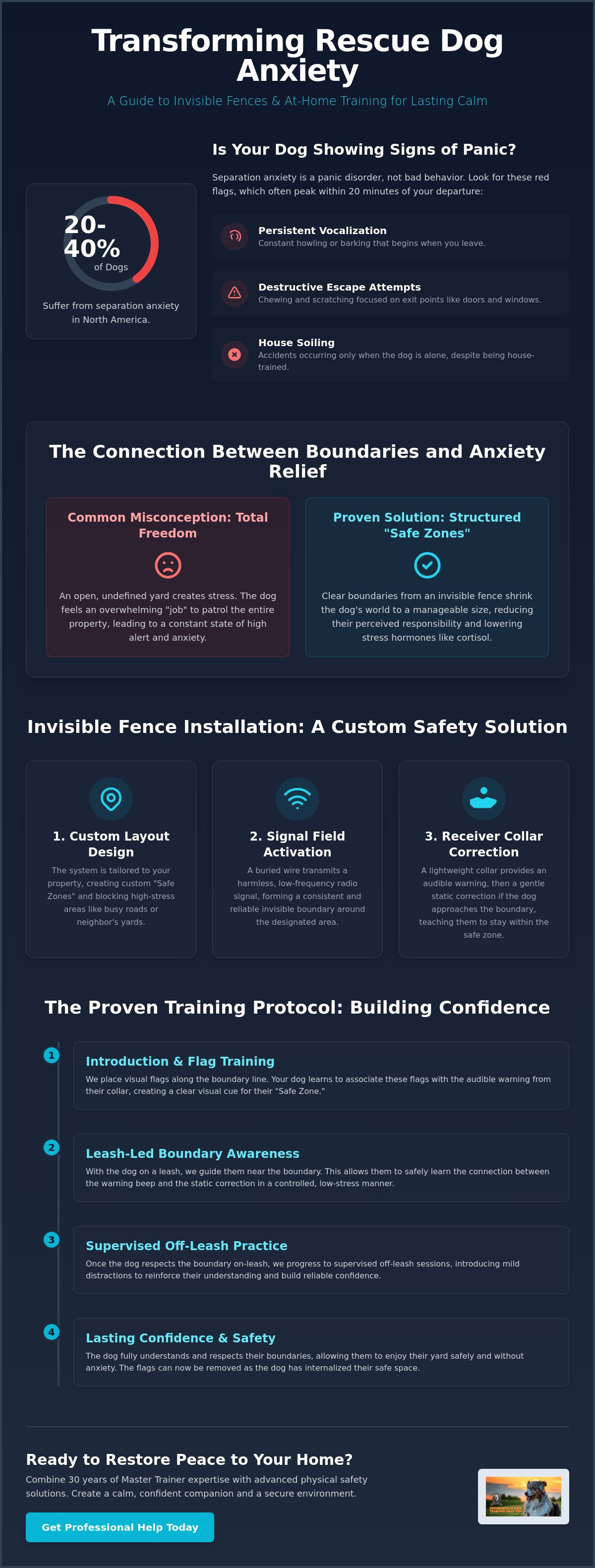
You return home to find a chewed door frame and a frantic rescue dog who spent the afternoon howling for your return. It is a heartbreaking scene that many New Jersey pet owners know too well. You adopted your dog to save them, yet their distress makes you feel like you are failing them. You aren't alone in this struggle. Statistics show that separation anxiety affects 20% to 40% of dogs in North America, often manifesting as property destruction or excessive barking that frustrates the neighborhood.
We understand the guilt and the domestic chaos that follows a rescue dog's transition into a new home. You can transform this anxiety into calm confidence through specialized at-home training for rescue dog separation anxiety NJ families rely on for real results. This guide explores how professional behavioral instruction paired with structured boundaries, such as an invisible dog fence installation, creates a secure environment. Learn how to establish clear leadership and use technical containment systems to help your dog finally feel safe in their own space. It is time to replace the cycle of panic with disciplined companionship.
Key Takeaways
Identify how New Jersey’s unique environmental triggers, like high-traffic noise and multi-family housing, exacerbate canine distress.
Learn why establishing physical "Safe Zones" through structured boundaries is essential for a rescue dog's psychological security.
Explore the technical requirements for a custom invisible dog fence installation designed to block out high-stress property zones.
Implement a proven training protocol for at-home training for rescue dog separation anxiety NJ families use to build lasting confidence.
Discover the advantage of a dual-service approach that combines 30 years of Master Trainer expertise with advanced physical safety solutions.
Table of Contents
What is Rescue Dog Separation Anxiety and Why is it Prevalent in NJ?
Separation anxiety in dogs is far more than a case of the "blues" when you leave for work. It is a legitimate panic disorder. For a rescue dog, your departure triggers a physiological fight-or-flight response. They aren't being spiteful; they are terrified. This condition is diagnosed in 20% to 40% of dogs in North America according to the American Veterinary Medical Association, and the numbers are often higher for those coming from shelter environments.
Living in the Garden State adds unique layers of stress to a dog's life. Suburban density in Monmouth County or the constant hum near the Garden State Parkway in Ocean County creates a sensory overload. Effective at-home training for rescue dog separation anxiety NJ residents need must account for these environmental stressors. When you add changing commute patterns to the mix, a dog's sense of routine shatters. They lack the structure needed to feel secure in high-energy environments like Hamilton or Toms River.
To better understand this concept, watch this helpful video:
Rescue dogs often carry the biological weight of past abandonment. This history makes them predisposed to over-attachment. They view their new owner as their only lifeline, which can quickly spiral into a suffocating dependency. Without clear boundaries, this attachment manifests as "Domestic Chaos." Watch for these red flags:
Persistent vocalization: Howling or barking that starts the moment the door closes.
House soiling: Accidents that occur only when the dog is left alone, despite being house-trained.
Escape attempts: Destructive behavior focused on exit points like doors and windows.
Distinguishing Panic from Boredom
A bored dog might chew a remote because it's available. A panicking dog destroys the door frame because it is the barrier between them and you. Observe your dog's "velcro" behavior when you are home. If they follow you from room to room, they are practicing for a panic attack. Most anxiety-driven destruction peaks within the first 20 minutes of your departure. Identifying this timing is a critical step in implementing at-home training for rescue dog separation anxiety NJ experts recommend.
The Emotional Toll on NJ Families
Nothing ruins a productive day like a long NJ commute followed by a noise complaint from a neighbor in Mercer or Burlington County. The "neighbor factor" is a significant stressor in our tight-knit communities. You feel trapped by your dog's fear, and the guilt can be overwhelming. Professional intervention from Pro-Dog K9 Academy focuses on moving your household from a state of chaos to one of disciplined companionship. We replace uncertainty with clear leadership and physical safety solutions.
The Connection Between Boundaries and Anxiety Relief
Many owners believe a rescue dog needs "total freedom" to overcome their past. This is a common misconception. For a dog suffering from Separation Anxiety, an open yard without clear limits is a source of stress, not relief. Without defined physical boundaries, your dog assumes the massive "job" of patrolling the entire property. This heightened state of alert makes it impossible for them to relax when you leave. They aren't just missing you; they are failing at a job they were never meant to have.
Structured at-home training for rescue dog separation anxiety NJ families implement focuses on shrinking the dog’s world to a manageable size. By establishing a "Safe Zone" through professional containment, we tell the dog exactly where their territory ends. This reduces their perceived responsibility to guard the house. When a dog understands their limits, their cortisol levels drop. They move from a state of constant surveillance to one of restful security. A defined boundary provides the psychological safety net that a rescue dog craves.
Why Traditional Fencing Often Fails Anxious Dogs
Physical fences are often part of the problem rather than the solution. A rescue dog with high drive sees the mail carrier, a neighbor, or a squirrel through the slats but cannot reach them. This creates intense barrier frustration. The dog's arousal levels spike, leading to frantic pacing, digging, or even dangerous attempts to jump over the structure. For an anxious pet, a physical fence acts as a viewing gallery for triggers. It keeps them in a state of high-arousal that carries over into the house long after they come back inside.
Creating a Psychological Anchor with Invisible Fencing
An invisible boundary works differently because it creates a consistent, predictable environment that doesn't rely on visual triggers. The dog learns to respond to an audible warning, which acts as a psychological anchor. This predictability is the foundation of confidence. A dog that feels secure in their outdoor boundaries is far more likely to remain calm indoors. Confidence is a transferable skill; as they master the yard, they master their own anxiety.
Success depends on professional calibration tailored specifically to your rescue dog’s temperament. We don't use a one-size-fits-all approach. We fine-tune the system to ensure the dog feels guided and safe. This specialized setup is a critical component of behavioral rehabilitation. If you want to stop the cycle of destruction, starting with at-home obedience training will establish the clear leadership your dog needs to finally feel at peace.
Invisible Dog Fence Installation: Custom Solutions for NJ Homes
NJ soil presents unique challenges. From the rocky terrain of the north to the sandy shores of the coast, a generic approach to pet containment fails. Installing an underground system requires strategic planning and a layout that addresses the specific stressors your dog faces daily. While seeking expert veterinary advice on separation anxiety is vital for behavioral health, physical containment provides the environmental control needed to succeed. We ensure the wire is buried at a depth that survives both the NJ freeze-thaw cycle and routine lawn maintenance.
We design custom layouts that create "off-limits" zones. If your rescue dog panics at delivery trucks or noisy NJ streets, we set the boundary back from the curb to create a buffer zone. This prevents the dog from reaching high-stress areas where their anxiety typically spikes. Professional at-home training for rescue dog separation anxiety NJ residents rely on starts with this technical foundation. A custom installation isn't just about containment. It is about keeping your dog away from the triggers that fuel their panic.
Mapping the Boundary for Maximum Security
Customizing the perimeter for Monmouth and Ocean County properties requires an eye for detail. Whether you have a half-acre suburban lot or a multi-acre estate, the signal must remain consistent across the entire property. We integrate the system with your existing landscaping to maintain curb appeal. There are no unsightly wires or bulky fences. This professional approach ensures there are no signal gaps that could lead to a breach of trust between you and your pet.
Technical Setup and Equipment Quality
Quality matters for long-term security. We use heavy-duty, professional-grade wire that far outlasts the thin, fragile lines found in retail kits. Our transmitters are calibrated to your dog's specific sensitivity and size. This ensures the "warning zone" is large enough for them to react calmly and move back. If your system ever encounters issues from landscaping accidents or age, our Invisible Fence Repair services ensure your dog's safety is never compromised for long.
DIY pitfalls are common and costly. A wire buried too shallow will eventually break, and a transmitter set incorrectly can confuse an already anxious rescue dog. Professional installation removes the guesswork. We handle the heavy lifting and the technical fine-tuning, allowing you to focus on the emotional bond with your dog. This precision creates a reliable "Safe Zone" that acts as the first step toward a more confident, relaxed pet.
The Training Protocol: Teaching Your Rescue Dog the Boundaries
Installation provides the infrastructure, but training provides the understanding. Success in at-home training for rescue dog separation anxiety NJ families depend on requires a disciplined, five-step protocol. We don't just turn on a system and walk away. We teach your dog to think and make confident choices. This process transforms their environment from a source of uncertainty into a predictable safe zone.
Step 1: Flagging the perimeter. These white flags act as a visual map for your rescue dog. They mark exactly where their world ends and the "off-limits" zone begins.
Step 2: Introduction to the audible warning tone. Your dog learns that the "beep" means "stop and turn back." This builds a clear association before any physical correction occurs.
Step 3: Supervised boundary testing. Under the guidance of our Master Trainer, your dog practices boundary recognition on a long lead. We ensure they understand the rules without feeling overwhelmed.
Step 4: Increasing distractions. We introduce "real world" triggers like passing neighbors, squirrels, or rolling balls to proof the boundary. This ensures they stay safe even when excited.
Step 5: Transitioning to off-leash confidence. Once your dog consistently respects the flags and tone, they earn the freedom of the safe zone.
Humane Remote Communication Techniques
Effective communication requires clarity, not force. We utilize Dogtra collar training as a sophisticated "tap on the shoulder." This remote communication tool allows us to guide your dog from a distance with precision. It's a firm but fair philosophy that prioritizes safety and clear instruction. Don't believe the myths that e-collars are punishment devices. In a professional's hands, they are tools for clarity that prevent the need for physical manhandling or shouting.
At-Home Obedience Integration
Boundary training works best when paired with foundational obedience. Commands like Sit, Stay, and Place build the focus your dog needs to ignore external stressors. For a dog with separation anxiety, "Place" training is a game-changer. It gives them a designated spot to relax during your departure routines. This breaks the cycle of them following you to the door in a panic. Our comprehensive at-home training for rescue dog separation anxiety NJ owners value builds mutual respect and clear leadership. It creates a household where the dog knows their role and feels secure in it.
If you are ready to replace domestic chaos with a disciplined companion, contact us for a professional at-home training evaluation.
Why NJ Families Trust Pro-Dog K9 Academy for Separation Anxiety
NJ families demand results because their time and property are valuable. We provide more than just a training service; we offer a behavioral philosophy rooted in over 30 years of industry experience. As a Master Trainer specialized in behavioral rehabilitation, I have seen every variation of canine panic. Our dual-service expertise sets us apart from competitors who only offer half of the solution. We don't just suggest boundaries; we provide expert Invisible Fence Installation while simultaneously addressing the psychological triggers behind the distress. This comprehensive approach is why our at-home training for rescue dog separation anxiety NJ programs succeed where virtual or classroom-based methods fail.
Our hands-on approach brings the solution directly to your front door. We serve homeowners across Monmouth, Ocean, Burlington, and Mercer County. We don't hide behind a screen or a generic facility wall. This focus on personalized, at-home care is a hallmark of premium pet services, much like the peluquería canina móvil Sotogrande that provides expert grooming in a stress-free environment. We work in your dog's real-world environment, dealing with the actual door frames they chew and the neighbors who hear their barking. Our success with aggression rehabilitation and complex separation anxiety cases has made us a local authority in canine behavior. We turn domestic chaos into disciplined companionship through efficiency and deep competence.
The Pro-Dog K9 Advantage
We reject "one-size-fits-all" programs. Your rescue dog has a unique history, and their training plan must reflect those specific experiences. We analyze past traumas and current triggers to build a customized roadmap for recovery. A critical part of this process is direct owner instruction. We teach you to be a skilled handler because the training must stick long after the session ends. You also gain access to professional-grade containment technology and specialized equipment that retail stores simply do not carry. We provide the tools and the knowledge to ensure your dog stays safe and calm.
Getting Started with a Master Trainer
The path to a calm home begins with an initial at-home assessment. We evaluate your dog's anxiety levels in the context of your specific property layout and daily routine. During your first session of At-Home Obedience Training, you will see immediate shifts in your dog's focus. We establish clear leadership from the very first interaction. Reclaim your home and your peace of mind. Contact Pro-Dog K9 Academy today to transform your rescue dog’s fear into disciplined confidence.
Reclaim Your Peace with Expert Behavioral Boundaries
Separation anxiety isn't a behavioral quirk; it's a panic response that requires a structured, professional solution. You now understand that combining professional invisible fence installation with clear obedience training creates a sanctuary where your rescue dog can finally relax. This approach removes the environmental triggers that fuel distress while establishing the leadership your pet needs to feel secure. Effective at-home training for rescue dog separation anxiety NJ families rely on must address both the physical safety and the psychological confidence of the animal.
With over 30 years of experience as a Master Trainer, I specialize in Dogtra E-Collar technology to provide humane, clear remote communication that builds trust. We proudly serve families throughout Monmouth, Ocean, Burlington, and Mercer Counties with hands-on solutions that deliver rapid improvements. It is time to move from a state of domestic chaos to one of disciplined companionship.
Schedule Your At-Home Rescue Dog Assessment with a Master Trainer
Your dog's distress doesn't have to define your home life. With the right boundaries and expert guidance, a calm and confident companion is well within your reach.
For those times when you are traveling or need extra support, facilities like Tails On Trails Pet Resort provide the professional daycare and boarding necessary to maintain your dog's progress in a safe environment.
Frequently Asked Questions
Can an invisible fence actually help a dog with separation anxiety?
Yes, an invisible fence helps by establishing a predictable Safe Zone that reduces environmental uncertainty. When a rescue dog understands their physical limits, they stop patrolling the entire property and focus on their designated area. This structured approach is a key component of at-home training for rescue dog separation anxiety NJ owners use to lower their pet's cortisol levels and build indoor relaxation.
Is at-home training better than group classes for a rescue dog?
At-home training is significantly more effective for rescue dogs because it addresses behavioral triggers in their actual living environment. Group classes often overwhelm anxious dogs with sensory overload, making learning nearly impossible. By training at home, we work on specific issues like door-bolting or yard boundaries where they actually occur, ensuring the results translate to your daily routine and household dynamic.
How long does it take to train a rescue dog on an invisible fence?
Most rescue dogs achieve reliable boundary recognition within 10 to 14 days of consistent training. The process begins with visual flags and audible tones, followed by supervised testing under distraction. While every dog's learning curve varies based on their specific history, our structured protocol ensures they understand the system's rules quickly and safely before transitioning to full off-leash freedom within the yard.
Are invisible fences safe for dogs with fear-based aggression?
Professional containment is often safer for dogs with fear-based aggression because it eliminates the barrier frustration caused by traditional physical fences. An invisible boundary prevents the dog from charging at the curb or fence line where they might feel trapped or cornered. This creates a buffer zone that keeps the dog away from high-stress triggers, reducing the likelihood of reactive outbursts or redirected aggression.
What happens if my invisible fence wire breaks in the middle of winter?
If a wire breaks during a New Jersey winter, our team uses specialized fault-finding equipment to locate the break through snow or frozen soil. You don't have to wait until spring for a solution. We provide year-round service to ensure your rescue dog's safety is never compromised by seasonal ground shifts or landscaping accidents that damage the integrity of the containment loop.
Do you provide invisible fence repair for systems you didn't install?
We provide comprehensive Invisible Fence Repair for all major brands, regardless of who performed the original installation. Our technicians carry professional-grade wire and transmitters to restore system integrity quickly. Whether your system has a simple wire break or a complex transmitter failure, we offer the technical expertise and high-quality components needed to get your pet's safe zone operational again without delay.
How much does at-home separation anxiety training cost in NJ?
Rates for the specialized at-home training for rescue dog separation anxiety NJ families seek vary based on the severity of the behavior and the number of sessions required. While national averages for private lessons range from $100 to $250 per hour as of March 2026, behavioral rehabilitation often involves custom packages tailored to the dog. We recommend an initial assessment to determine your dog's specific needs.
Can an older rescue dog still learn to use an invisible fence?
Older rescue dogs are excellent candidates for invisible fence training and often learn faster than impulsive puppies. Their maturity allows them to focus on audible warning tones and visual cues with greater patience and understanding. As long as the dog is healthy and has functional hearing, we can successfully teach them the boundaries of their safe zone at any age, providing them with newfound confidence.


Comments