


Troubleshooting Invisible Fence Collar NJ: The Expert Containment Guide
Imagine the panic of seeing your dog ignore the boundary and head toward a busy New Jersey intersection because their collar failed to trigger. It's a terrifying scenario that every local pet owner fears. You invested in a containment system for security, but now you're stuck staring at a blinking light or listening to a confusing beep from the transmitter.
We understand the frustration of DIY fixes that don't hold up and the anxiety of a system you can't trust. This guide simplifies troubleshooting invisible fence collar NJ so you can stop the guesswork and start protecting your dog again. You'll learn how to diagnose specific collar failures, fix signal issues, and determine if your pet needs a training refresher or if the hardware requires a professional hand.
From battery checks to identifying wire breaks, we provide the expert steps needed to keep your dog safely contained on your property. We'll walk you through the technical and behavioral adjustments that move your home from a state of chaos back to disciplined companionship. Let's get your system back online and your pet back to safety.
Table of Contents
Identifying the Signs of Invisible Fence Collar Failure
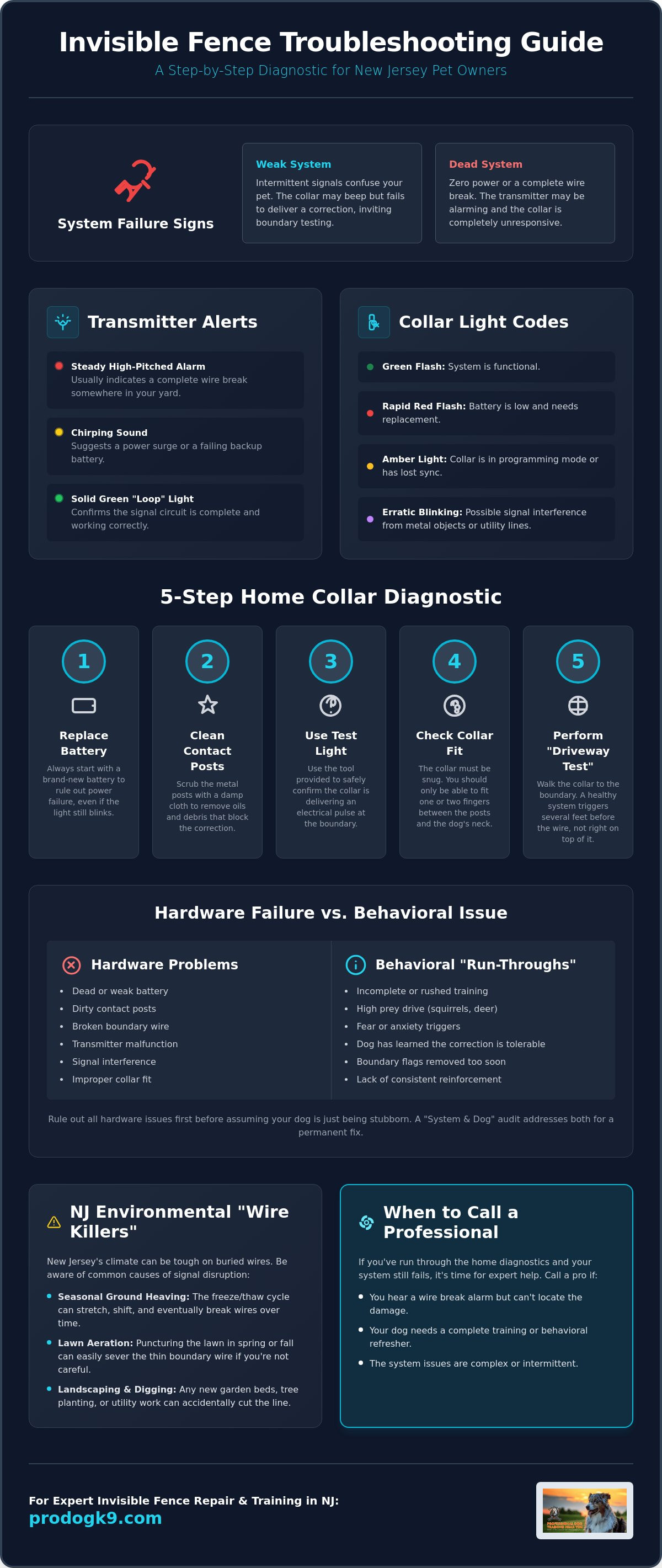
Effective pet containment relies on a perfect technical handshake between two components. A failure occurs when the communication loop between the wall-mounted transmitter and the dog's receiver collar breaks. Without this constant dialogue, electronic pet containment systems cannot enforce the boundaries you've established. When this link fails, your NJ property is no longer a secure environment for your pet.
You might notice your dog ignoring the flags or perhaps the collar beeps but fails to deliver a correction. These symptoms often point to a system that's "weak" rather than "dead." A dead system has zero power, while a weak one suffers from intermittent signals that confuse your pet and invite them to test the boundary. If your dog has suddenly started testing the line, the hardware is the first place to look. Identifying these signs early prevents the domestic chaos of a lost or injured animal.
To better understand how to check your system, watch this helpful video:
To quickly verify performance, use the "Driveway Test." Take the collar off your dog and walk it toward the boundary at your driveway entrance. Hold the collar at your dog's neck height; don't swing it by the strap. If the collar fails to activate until you're standing directly over the wire, your signal field has likely collapsed. This is a critical step in troubleshooting invisible fence collar NJ before assuming your dog is simply being stubborn. A healthy system should trigger several feet before the wire.
The Beeping Transmitter: What the Alarms Mean
Your transmitter acts as the brain of the operation. If you hear a steady, high-pitched alarm, it usually indicates a physical wire break somewhere in the yard. A chirping sound might suggest a power surge or a failing backup battery. Check the "Loop" light immediately. A solid green light confirms the circuit is complete. A red light or no light at all means the signal isn't traveling through the buried wire. This diagnostic prevents you from wasting time on the collar when the issue is actually in the ground.
Collar Light Codes: Blinking Red, Green, and Amber
Modern receivers use LED signals to communicate their status. For professional-grade brands like Dogtra, a green flash every few seconds means everything is functional. A rapid red flash is the universal signal for low battery health. Amber lights often indicate the collar is in a programming mode or has lost its sync with the transmitter. Signal interference is a specific issue where external electronic frequencies cause the collar to activate randomly even when the dog is far from the boundary. If you see erratic blinking, check for nearby metal objects or underground utility lines that might be bleeding into your fence signal.
5 Steps to Diagnosing Your Dog’s Receiver Collar at Home
When your dog starts testing the boundaries, you need a systematic approach to identify the culprit. Troubleshooting invisible fence collar NJ issues at home saves time and quickly restores safety. Follow these five professional steps to audit your hardware before assuming the entire system is broken.
Step 1: Replace the battery with fresh cells. Don't trust a blinking green light. High-drive dogs or frequent boundary testing can drain a battery faster than the manufacturer suggests. Swap in a brand-new battery to rule out power drops that cause intermittent failure.
Step 2: Scrub the stainless steel contact posts. New Jersey mud, skin oils, and dead hair create a thick film on the posts. This residue acts as an insulator, preventing the correction from reaching the dog's skin. Use a damp cloth and mild soap to ensure the metal is shiny and clean.
Step 3: Use a test light tool. Testing the correction with your hand is dangerous and inaccurate. Hold the plastic test light tool against the contact posts and walk toward the boundary. This confirms the electrical pulse is firing and helps you spot potential collar malfunctions that a simple beep won't reveal.
Step 4: Inspect the collar strap for wear. Nylon straps stretch when wet, and plastic collars can crack during cold NJ winters. A loose strap allows the receiver to hang too low, breaking the contact necessary for a consistent correction.
Step 5: Verify the transmitter signal field width. Check the range dial on your wall-mounted unit. If the field is set too narrow, your dog will be past the wire before the collar has time to react. A wider field provides the necessary reaction time for the animal to turn back.
Testing the Correction Without the "Shock"
The test light tool is your best friend during a diagnostic. It allows you to see the intensity of the pulse without any physical risk. Listen closely for the "warning beep" that should trigger at least two to three feet before the actual correction. If you find areas in your yard where the beep stops or the light won't flicker, you've identified "dead spots." These are often caused by interference from buried utility lines or large metal objects like sheds.
Optimizing Contact Post Fit
Fit is the most common reason for containment failure. Position the receiver high on the dog's neck, near the ears, rather than letting it hang near the chest. Apply the "Two-Finger Rule" by ensuring you can snug exactly two fingers between the contact posts and your dog's skin. If your pet has a thick double coat, you must use longer contact posts to penetrate the fur. A firm, consistent fit is the only way to ensure the message is received. If your hardware is functional but the behavior persists, a professional training audit can help reset your dog's respect for the line.
Why Your Dog Is Ignoring the Fence: Hardware vs. Behavioral Issues
Owners often insist their dog is simply "too tough" for an electronic system. This is a common misconception. In reality, a dog ignoring the boundary is usually a victim of poor calibration or a breakdown in their training. While there are clear advantages and disadvantages to invisible containment, the most significant "con" is almost always human error in managing the dog's psychological respect for the line.
If you've finished troubleshooting invisible fence collar NJ hardware and confirmed the signal is strong, you're likely dealing with a "run-through." This occurs when a dog's prey drive, such as chasing a squirrel or a neighbor's pet, becomes more rewarding than the correction is punishing. If the correction level is set too low for the dog's specific drive, they learn to endure a split second of discomfort to reach their goal. This isn't a hardware failure; it's a behavioral breakthrough that requires immediate intervention.
Dogs are incredibly observant. They don't just feel the correction; they listen for the warning beep. If they realize the beep is missing because a battery died or a wire broke, they'll seize the opportunity to cross. Once a dog successfully escapes a non-functional boundary, their respect for the system evaporates. You can't just fix the wire and expect them to stay. You must perform a focused re-training protocol to restore the psychological barrier that was lost during the hardware downtime.
Correction Level Calibration
Every dog has a unique threshold for communication. A shy, sensitive dog might respond perfectly to a vibration, whereas a high-drive breed may require a higher static level to break their focus on a distraction. If your dog flinches but continues to cross, they've become desensitized. Consult our dogtra collar training guide to learn how to humanely find the "working level" that commands respect without causing unnecessary stress. Consistency is the foundation of mutual understanding.
The Role of Reinforcement Training
A functional collar is just a tool, and the flags are the visual map. Without consistent reinforcement, the dog eventually forgets where the safe zone ends. We recommend spending 10 minutes a week "refreshing" the boundary rules with your pet. Walk the perimeter together and use positive reinforcement, like high-value treats, to reward them for immediately backing away when they hear the warning tone. This turns a negative correction into a positive choice, moving your home from a state of domestic chaos to one of disciplined companionship.
Managing Wire Breaks and Environmental Interference in New Jersey
New Jersey lawns face unique environmental pressures that often lead to hidden containment failures. While you might focus on the receiver, the buried wire is the literal lifeline of your system. Landscaping habits like power edging and aeration are the primary "wire killers" in the Garden State. One misplaced blade can sever the loop, instantly turning your secure yard into an open field. If your transmitter alarm is screaming, you're likely hunting for a break caused by a lawn service or seasonal soil movement.
Finding a break without the right tools is like searching for a needle in a haystack. A professional wire break locator is essential. This device sends a distinct frequency through the line, allowing you to trace the path until the signal vanishes at the point of the break. Beyond physical cuts, signal consistency is often compromised by metal interference. Large metal objects like aluminum siding, galvanized gutters, or buried utility pipes can bleed the signal or create "shadows" where the collar fails to activate. When troubleshooting invisible fence collar NJ systems, always look for these environmental anchors that might be distorting your boundary.
Moisture infiltration is why DIY wire splices often fail after just one NJ winter. Many homeowners attempt to twist wires together and wrap them in electrical tape. This is a mistake. The constant exposure to damp soil causes rapid corrosion, leading to a "partial break" where the transmitter shows a green light but the signal is too weak to trigger the collar. Professional repairs require waterproof grease capsules and heat-shrink tubing to ensure the connection remains airtight through the seasons.
NJ Seasonal Impacts on Underground Fences
The freeze-thaw cycle in Mercer and Monmouth counties is particularly brutal on buried electronics. As the ground heaves during the winter, it can stretch and snap wires that weren't installed with enough slack. Spring brings a different threat: lightning. NJ spring storms frequently cause power surges that can fry a transmitter if it isn't properly grounded. Always check the ground wire connection at the transmitter to ensure your hardware is protected from the next heavy cell moving through the region.
Beyond protecting your underground wiring from New Jersey's seasonal weather patterns, it is also a great time to check out Absolute Chimney Pros to ensure your home's chimney is safe and prepared for the months ahead.
DIY vs. Professional Wire Repair
A simple splice kit might suffice for a visible cut on the surface, but underground issues require more precision. Using the wrong gauge wire for a repair creates resistance imbalances that shorten the life of your transmitter. If your system is plagued by intermittent beeping or dead zones you can't find, it's time to stop the guesswork. Our team provides invisible fence repair near me to restore your loop to factory standards. Don't risk your dog's safety on a temporary fix; invest in a professional invisible fence repair to secure your perimeter for good.
Professional Invisible Fence Repair and Training Solutions in NJ
When home diagnostics reach their limit, you need a solution that addresses the entire containment ecosystem. Troubleshooting invisible fence collar NJ systems often reveals complex issues that require more than a simple battery swap or a basic wire splice. Pro-Dog K9 Academy brings over 30 years of industry experience to every service call. We don't just act as technicians; we act as behavioral mentors who understand the weight of your pet's safety. While generic repair services might fix a broken wire, they often overlook the psychological impact that a failing fence has on a dog's respect for the boundary.
Our comprehensive "System & Dog" audit is our proprietary approach to total security. We simultaneously evaluate the mechanical integrity of your hardware and the behavioral response of your pet. By integrating expert invisible fence installation NJ with specialized obedience training, we ensure your system is calibrated perfectly for your dog's unique temperament. We serve homeowners throughout Monmouth, Ocean, Burlington, and Mercer Counties with rapid-response repair services designed to end domestic chaos and restore peace of mind. Fixing the wire is only half the battle; reinforcing the behavior is what keeps your dog safe.
The Pro-Dog K9 Advantage
We specialize in the latest containment technology, including Dogtra E-Collar systems and high-durability underground wiring. Our at-home service model allows us to address your dog's behavior in their natural environment where distractions are real and boundaries are tested. We're committed to humane, effective containment that lasts because we believe the bond between owner and animal is built on clear leadership and mutual respect. This professional depth distinguishes our hands-on approach from theoretical competitors who only understand the electronics and not the animal behind the collar.
Booking Your NJ Fence Diagnostic
A professional diagnostic visit is a streamlined process designed for maximum efficiency. When our expert arrives, they'll perform a full loop test and a collar signal check to identify any hardware discrepancies. To prepare for the visit, ensure your yard is accessible and your dog is ready for a brief behavioral assessment near the boundary flags. We'll identify the root cause of your containment failure and provide a clear, actionable plan to fix it permanently. Stop the frustration of DIY fixes that don't hold up. Contact Pro-Dog K9 Academy today for expert NJ fence repair!
Secure Your Perimeter and Protect Your Pet
You now possess the foundational knowledge to determine if your containment failure is a mechanical glitch or a behavioral breakthrough. Reliable pet safety depends on a functional loop and a dog that respects the warning beep. By mastering the art of troubleshooting invisible fence collar NJ, you can quickly identify battery drains, wire breaks, and training regressions before they lead to a dangerous escape.
Don't let a failing system keep your family in a state of anxiety. Pro-Dog K9 Academy brings a Master Trainer with 30+ years of experience directly to your door. We specialize in Dogtra and all major containment brands, providing expert diagnostics across Monmouth, Ocean, Burlington, and Mercer Counties. Our team addresses both the hardware and the behavior to ensure your fence works exactly as intended. Stop the guesswork and restore your dog's disciplined companionship with a solution built on industry expertise and mutual respect.
Get Expert Invisible Fence Repair in NJ Today
Your dog deserves a safe space to play, and you deserve the confidence that they'll stay there. Take the first step toward a secure yard today.
Frequently Asked Questions
Why is my invisible fence transmitter beeping every few seconds?
A beeping transmitter usually signals a physical break in your buried boundary wire. Check the unit for a red or blinking "Loop" light, which confirms the electrical circuit is incomplete. This alarm ensures you know the perimeter is compromised before your dog discovers it. You can attempt to find the break with a locator tool or call an expert for a rapid-response repair.
How long do invisible fence collar batteries typically last in NJ?
Most collar batteries last between three and four months under normal conditions. In New Jersey, extreme temperature shifts during the winter can drain battery voltage faster than usual. We recommend setting a calendar reminder to replace cells every 90 days. Proactive replacement is a key step in troubleshooting invisible fence collar NJ to prevent a total containment failure.
Can I fix a broken underground fence wire myself?
You can perform a temporary fix with a waterproof splice kit, but DIY repairs often fail during the next freeze-thaw cycle. Standard electrical tape won't keep moisture out of the connection. For a permanent solution, professional heat-shrink tubing and grease capsules are required to prevent corrosion. Reliable repairs ensure the signal remains strong through all seasons.
Why does my dog’s collar beep but not provide a correction?
This occurs when the battery voltage is high enough to trigger the audio warning but too low to generate the static pulse. Dirty or oxidized contact posts can also insulate the correction from reaching the dog's skin. Clean the metal posts with a damp cloth and install a fresh battery. If the issue persists, the internal receiver circuitry may be damaged.
Is my invisible fence collar waterproof for NJ snow and rain?
High-quality receiver collars are designed to be fully waterproof and submersible. They can easily withstand heavy NJ rain, deep snow, and mud. However, check for cracks in the plastic housing that could allow internal moisture seepage. If the seal is compromised, the collar will malfunction during the next storm and require immediate professional attention.
How do I know if my dog needs a higher correction level?
If your dog flinches but continues to run through the boundary, they've learned to ignore the current setting. This indicates their drive is higher than the correction's impact. You must find a "working level" that breaks their focus without causing distress. A Master Trainer can help you calibrate the intensity to match your dog's specific temperament and drive.
What should I do if the collar is causing skin irritation on my dog?
Remove the collar immediately and consult your veterinarian if the skin is broken. This irritation, known as pressure necrosis, happens when the contact posts press against the skin for more than 12 hours. Rotate the collar's position on the neck daily and remove it at night. Ensure you aren't over-tightening the strap beyond the two-finger rule we discussed earlier.
Can signal interference from a neighbor’s fence affect my system?
Neighboring systems can cause signal bleed if they operate on the same frequency and are installed within ten feet of your wire. You might notice your collar beeping in the middle of your yard or failing near the property line. Modern systems allow you to switch frequencies to avoid this interference. Adjusting your signal width can also help isolate your boundary from external noise.


Comments