


Dog to Dog Aggression Training: The Master Trainer’s Guide to Rehabilitation (2026)
Updated: Jun 3
Your dog isn't a "bad" animal, and you haven't failed as an owner just because a walk through your Monmouth County neighborhood feels like a legal liability waiting to happen. With dog bite insurance claims hitting $1.12 billion in recent years, the stress you feel is a rational response to a serious breakdown in communication. You want to enjoy your pet, but instead, you're trapped in a cycle of embarrassment and fear. It's a heavy burden to carry, especially when you feel like you've tried everything to stop the lunging and growling.
We understand the exhaustion of scanning every corner for triggers and the heartbreak of seeing your companion struggle. It's time to stop managing the chaos and start solving the root cause. This guide provides the professional at-home strategies you need for effective dog to dog aggression training. You'll learn how to establish trust through clear leadership and move from domestic stress to disciplined companionship. We'll explore the proven path to rehabilitation, from identifying subtle behavioral shifts to using the right tools for real-world success in your own driveway.
Key Takeaways
Identify the difference between fear-based reactivity and dominance-driven aggression to apply the correct rehabilitation strategy for your dog.
Learn why professional dog to dog aggression training is most effective when conducted in your own neighborhood where real-world triggers actually happen.
Discover how a Dogtra E-Collar functions as a digital leash to provide clear, humane communication during high-stress encounters.
Master the Threshold concept and the Look at That game to stop reactive outbursts before they escalate into dangerous situations.
Establish yourself as a confident leader to build a bond of mutual respect and enjoy peaceful walks throughout Monmouth or Ocean County.
Table of Contents
What is Dog to Dog Aggression and Why Does It Happen?
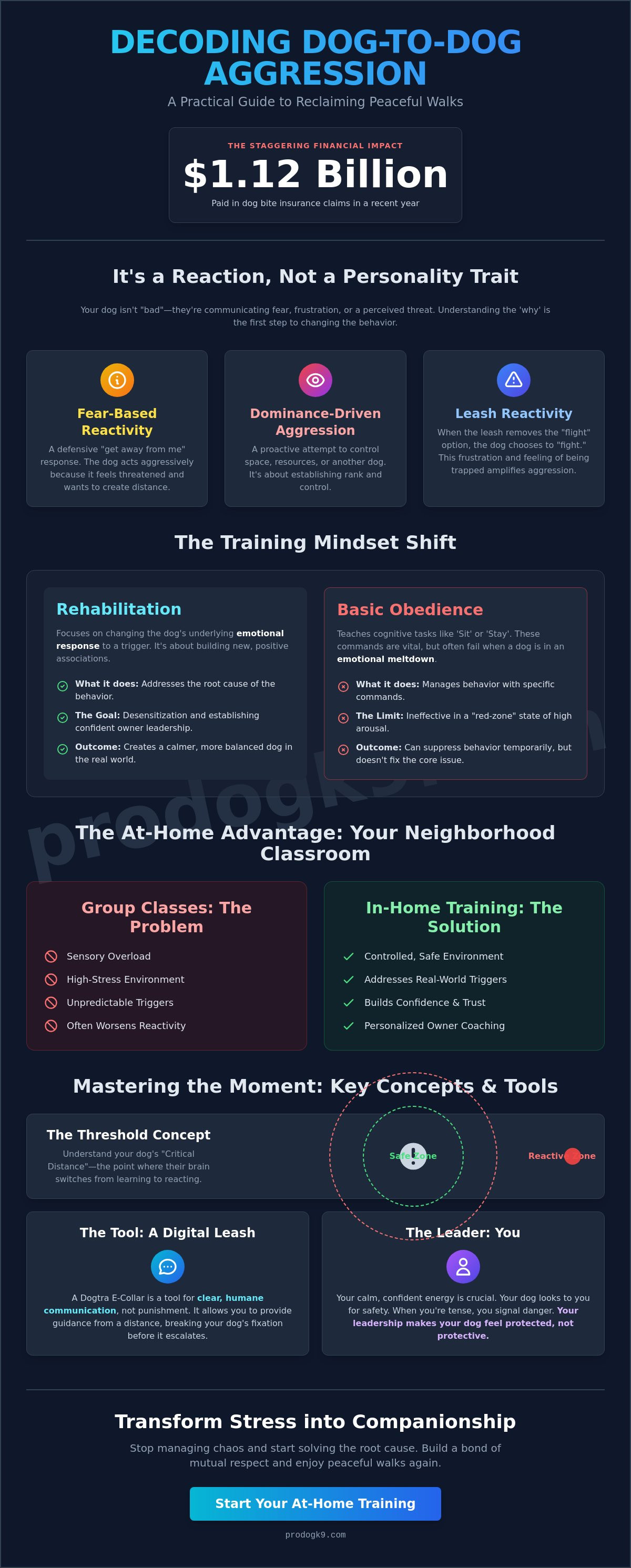
Dog aggression is an emotional reaction, not a fixed personality trait. When your dog lunges at a neighbor's pet, they aren't being "bad." They're communicating a state of high arousal, fear, or frustration. Understanding this distinction is the first step in successful dog to dog aggression training. For a comprehensive Dog aggression overview, we see that these behaviors often stem from complex environmental and biological factors.
We categorize these responses into three primary areas. Fear-based reactivity is a defensive "get away from me" response. Dominance-driven aggression is a proactive attempt to control space or resources. Predatory drift is different; it occurs when a dog's play drive shifts suddenly into a hunting instinct. Many owners also struggle with leash reactivity. This phenomenon occurs because the leash removes the "flight" option from the dog's natural fight-or-flight response. Trapped and unable to move away, the dog chooses to fight. While past trauma is a common culprit, a lack of structured socialization during the critical developmental window is just as likely to cause adult reactivity. To address these complex behaviors, you can explore Reactive Dog Training through I Wuff You Dog Training’s specialized behavior consulting.
Common Triggers for Aggressive Behavior
Every dog has a "Critical Distance" threshold. This is the specific radius where your dog feels safe. Once a trigger crosses this invisible line, the reactive brain takes over. Watch for silent precursors like fixed eye contact, a stiffened tail, or a closed mouth. These signals happen seconds before the explosion. Your own stress plays a role, too. When you tighten your grip on the leash, you send a physical signal of panic directly to your dog, confirming their belief that the approaching animal is a threat. You can learn more about identifying these critical thresholds and how to manage them effectively by consulting professional behavioral resources.
Rehabilitation vs. Basic Obedience
Basic obedience commands like "Sit" or "Stay" are vital skills, but they often fail in a red-zone state. You cannot ask a dog to perform a cognitive task when they are in the grip of an emotional meltdown. When you commit to professional dog to dog aggression training, you move beyond simple commands. While obedience focuses on teaching a specific physical action, rehabilitation focuses on changing the dog's underlying emotional response to a trigger. This level of specialized behavioral modification is a hallmark of quality dog training elk grove ca, where aggression rehabilitation is treated as a dedicated process of desensitization and leadership.
The At-Home Advantage for Aggression Training in NJ
Group classes are often the worst environment for a reactive dog. Imagine trying to learn a complex new skill while surrounded by your greatest fears. That's exactly what a group setting feels like for an aggressive animal. It's sensory overload. Effective dog to dog aggression training requires a controlled, surgical environment where we can dictate the level of exposure. By bringing the training directly to your home, we eliminate the stress of a commute and the unpredictable chaos of a crowded facility. We start where your dog is most comfortable, ensuring their brain stays in a learning state rather than a survival state. This focus on a structured, low-stress atmosphere is a standard shared by professional facilities like Noah's Pet Hotel & Spa, which provides expert care for pets in a controlled boarding environment.
Triggers don't live in a sterile training center. They live on your street, at your front door, and behind your neighbor's fence. Training in the "Real World" allows us to address these specific flashpoints as they occur. Identifying the Signs of dog aggression is much more productive when we are standing on the very sidewalk where the lunging usually starts. Whether you're in Monmouth or Mercer County, your daily walking route is our classroom. This localized approach ensures that the progress you make translates directly to your everyday life.
Eliminating Environmental Stressors
We leverage the "Home Turf" advantage to build your dog's initial confidence. Your backyard or driveway serves as a safe neutral zone where we can introduce new communication cues without the pressure of outside triggers. Once the foundation is solid, we move the session to your specific neighborhood. We don't just teach general concepts. We solve the exact problems you face, like the neighbor's barking dog or the high-traffic intersection at the end of your block. This gradual exposure is the key to lasting rehabilitation.
Personalized Coaching for the Owner
You are the other half of the leash. Your body language accounts for 50% of the training outcome. If you're tense, your dog is on high alert. We coach you to project a leadership dynamic that makes your dog feel protected rather than protective. They need to know you have the situation under control so they don't feel the need to intervene. This foundation of trust is essential, especially in homes with multiple pets. If you're also managing a younger dog, our guide to puppy training 101 provides the necessary groundwork to maintain a balanced household. Taking control of your walks starts with a professional assessment of your home environment. You can schedule an aggression rehabilitation session to begin this transformation today.
Tools for Success: Dogtra E-Collars and Remote Communication
Clear communication is the antidote to domestic chaos. When your dog enters a reactive state, their world narrows to a single target. This tunnel vision makes verbal commands useless. You need a tool that cuts through the noise without adding more stress to the situation. We utilize the Dogtra E-Collar as a "Digital Leash." It provides a clear, tactile signal that bridges the gap between species when physical leashes and vocal cues fail. It's about establishing a connection that your dog can actually feel and understand during high-arousal moments.
Many owners hesitate at the mention of remote collars due to outdated myths. Modern technology is about precision, not punishment. In a study on dog training methods, researchers analyzed the prevalence and effectiveness of various techniques used for behavioral issues. When applied by a Master Trainer, remote communication is a humane, low-level tap on the shoulder. It's a whisper, not a shout. This nuanced approach is vital for successful dog to dog aggression training because it allows you to communicate with your dog at the exact moment they begin to fixate on a trigger, stopping the escalation before it starts.
Mastering Remote Communication
Success lies in "Low-Level" stimulation. We don't use the collar to scare the dog. We use it to get their attention. Think of it as a physical "excuse me" that redirects their focus back to you. This redirection is crucial for reinforcing a reliable recall. Even in high-distraction environments, your dog learns that your signal takes priority over the presence of another animal. For a deep dive into the technical aspects, refer to our Dogtra collar training guide to understand the specific setup and levels required for your pet.
Safety and Containment in Your Yard
Containment is the first step in responsible aggression management. If your dog is constantly charging the property line to bark at passersby, they're practicing the very behaviors we want to eliminate. Invisible fencing creates a clear boundary that prevents territorial aggression from escalating at the edge of your lawn. However, a broken wire or a malfunctioning transmitter can compromise your progress. If your system is failing, searching for invisible fence repair near me ensures your yard remains a secure training environment. A safe perimeter allows you to focus on rehabilitation without the fear of an accidental escape or a dangerous neighborly encounter. If you are also looking for high-quality care for your feline companions while you focus on these training goals, you can check out Noah's Pet Hotel & Spa for professional cat boarding services.
Step-by-Step: How to Manage an Aggressive Encounter
Management is not about hiding in the shadows or walking your dog at midnight to avoid the neighborhood. It is about active, decisive leadership in the face of conflict. To succeed in dog to dog aggression training, you must first master the "Threshold" concept. This is the specific distance where your dog notices another animal but hasn't yet lost their cognitive focus. If your dog refuses a high-value reward, stops blinking, or ignores your voice, they are over threshold. You've moved from a training moment into a survival moment. Your primary goal is to recognize this bubble and maintain it before the first lunge occurs.
Proper leash handling is your most direct line of communication. Stop choking up on the lead. When you shorten the leash and pull tight, you send a pulse of physical tension directly to your dog's neck. This tension confirms their belief that the approaching dog is a threat. Instead, maintain a "J-Loop." This slight slack in the leash allows your dog to feel unconstrained, which significantly lowers their arousal level. If a situation becomes too high-pressure, execute an emergency U-Turn. Don't hesitate or look back. Turn your body, give a clear directional cue, and move away decisively. Once you are clear of the trigger, allow your dog to sniff the grass or shake their body. This post-encounter decompression resets their nervous system and prevents "trigger stacking," where small stressors build up into a massive explosion later in the walk.
The 3-Second Rule for Social Interaction
Social interactions between dogs often fail because humans don't respect the 3-second rule. In the canine world, a stare longer than three seconds is a challenge, not a greeting. Watch for "Hard Eyes" and a stiff, vibrating tail. These are the silent precursors to a bark. You must advocate for your pet. If another owner approaches, tell them clearly: "No greeting." It isn't rude; it's responsible ownership. Protecting your dog from unwanted interactions is the fastest way to build the trust necessary for rehabilitation; for those who eventually want to reintroduce supervised social settings, you can explore Full Day Doggy Daycare at Noah's Pet Hotel & Spa for a safe and professional experience.
Counter-Conditioning Techniques
Counter-conditioning turns a perceived threat into a positive cue. We use the "Look at That" (LAT) game to change the dog's emotional state. When your dog glances at a trigger and remains calm, acknowledge that choice and reward them immediately. Over time, the sight of another dog becomes a signal for them to look at you for leadership. This process is much more effective when you've already established a baseline of focus through dog obedience training at home. If you're ready to stop managing the chaos and start seeing real-world results, schedule your professional Aggression Rehabilitation session today.
Professional Aggression Rehabilitation in New Jersey
Experience is the only substitute for uncertainty when dealing with high-risk behavioral cases. You don't need a trainer who reads from a manual; you need a Master Trainer with 30+ years of hands-on experience in the trenches of behavioral correction. At Pro-Dog K9 Academy, we've spent decades transforming "lost causes" into reliable companions. Our philosophy isn't based on theoretical classroom scenarios. It's built on thousands of successful rehabilitations in real-world environments. We understand that your dog’s behavior is a direct reflection of their communication with you, and we provide the tools to fix that dialogue permanently.
Our approach to dog to dog aggression training is customized and results-oriented. We bring our expertise directly to your doorstep, serving families throughout Monmouth, Ocean, Burlington, and Mercer Counties. By conducting sessions at your home, we observe the exact triggers and environmental factors that contribute to your dog's reactivity. This isn't just about stopping a bark. It's about a total behavioral overhaul that moves your household from domestic chaos to a state of disciplined companionship. The path forward begins with a comprehensive evaluation and ends with a dog that looks to you for direction in every situation.
Reclaiming Your Neighborhood Walks
We've seen incredible success stories with "Red Zone" dogs in Burlington and Mercer counties that owners thought were beyond help. These weren't just minor leash pullers; these were dogs with significant histories of aggression that now walk calmly past triggers. Professional, hands-on instruction gives you the peace of mind that comes with knowing exactly how to handle any encounter. You'll stop dreading the sight of another dog and start enjoying the bond you share with your pet. You can learn more about the history and expertise that defines a professional behavior academy; booking an introductory at-home session allows us to assess your dog’s threshold and create a roadmap for their specific rehabilitation needs.
Once your dog has achieved a stable temperament, you can begin to enjoy the convenience of professional pet services again. For those who want to ensure their pet receives the highest level of attention, you can explore Overnight Care through premium providers like The Fur Seasons, who specialize in personalized animal welfare.
In addition to luxury grooming, finding a reliable boarding facility is essential for a balanced lifestyle. Tails On Trails Pet Resort provides a professional daycare and boarding experience that prioritizes the safety and individual needs of every dog.
For those who may be traveling or looking for high-quality care in the Harrisburg area, you can visit Noah's Pet Hotel & Spa to explore their professional boarding and daycare services that prioritize animal welfare and safety.
Why Pro-Dog K9 Academy?
We offer a unique dual-service signature that combines deep behavioral expertise with practical physical containment solutions. Whether it's mastering the Dogtra E-Collar for remote communication or ensuring your yard is secure, we cover every angle of animal welfare. You get direct access to a Master Trainer who understands the local NJ environment and the specific challenges of your community. We don't just train your dog; we mentor you to become the leader your dog needs. Don't let another day pass in a state of stress and isolation. Schedule your at-home aggression rehabilitation session today!
Reclaim Your Peace of Mind and Your Neighborhood
You don't have to live in a state of constant vigilance. Aggression isn't a life sentence for your pet; it's a communication gap that we can bridge together. By choosing specialized dog to dog aggression training, you're investing in a future of peaceful walks and a deeper bond built on mutual respect. We've established that the environment matters, the tools matter, and your leadership matters most of all. It's time to move from a state of domestic stress to one of disciplined companionship.
Pro-Dog K9 Academy brings the weight of 30+ years of real-world experience directly to your driveway. We specialize in the precision of Dogtra E-Collar communication to ensure your dog hears you even in the most high-pressure moments. Our Master Trainer serves Monmouth, Ocean, Burlington, and Mercer Counties with a commitment to tangible results. Stop managing the chaos and start the rehabilitation process today.
Get Expert At-Home Aggression Rehab in NJ—Contact Pro-Dog K9 Academy
Your journey toward a disciplined, happy companion is just one session away. Trust the process, take the lead, and enjoy the walks you and your dog deserve.
Frequently Asked Questions
Can a dog who has already bitten another dog be rehabilitated?
Yes, most dogs with a bite history can be successfully rehabilitated through structured behavioral modification and clear leadership. We focus on identifying the root cause of the bite, whether it was fear or dominance, to change the dog's emotional response. While safety protocols must always be maintained, a single incident does not mean your dog is beyond help. We provide the professional tools and strategies to ensure these incidents don't happen again.
How long does it take to see results in dog to dog aggression training?
You should see noticeable changes in your dog's focus and management within the first few sessions. True rehabilitation is a process that depends on the severity of the behavior and the owner's consistency at home. Our goal is to provide you with the tools to handle triggers immediately while working toward a long term shift in your dog's temperament. Consistency is the key to moving from domestic chaos to disciplined companionship; to better understand the professional investment required for these results, you can learn more about average training costs.
Will my dog ever be able to play with other dogs again?
The goal of rehabilitation is often neutrality rather than forced social play. Many reactive dogs can learn to coexist peacefully and ignore other animals, but they may never be the type of dog that enjoys a crowded park. We prioritize safety and trust, helping your dog feel secure enough that they no longer feel the need to react aggressively toward their peers. Success is a dog that remains calm and focused on you, making them better candidates for structured care environments like Tails On Trails Pet Resort when you need professional daycare or boarding.
Is at-home training better than a board and train program for aggression?
Training in your own environment is often superior because it addresses triggers where they actually occur. Board and train facilities can create a sterile success that fails once the dog returns to their own neighborhood. At-home dog to dog aggression training ensures the progress you make is practical and sustainable in your daily life. You need to be the one the dog respects and follows in your own driveway.
While at-home training is the gold standard for rehabilitation, choosing a high-quality boarding facility is essential for times when you are away. You can learn more about Noah's Pet Hotel & Spa to discover how their professional boarding and daycare services in Harrisburg and Mechanicsburg prioritize the safety and individual needs of every pet.
What should I do if my dog is attacked by another dog during training?
Move your dog away from the situation immediately and remain as calm as possible to prevent further arousal. Once you are at a safe distance, check for injuries and allow your dog to decompress in a quiet space. We teach emergency maneuvers and leadership skills so you can advocate for your dog and prevent these encounters from derailing your training progress. Your job is to be the protector so your dog doesn't have to be; to build your own physical confidence in high-stress situations, you can visit Performance Krav Maga for practical self-defense training.
Do you use treat-based training or correction-based training for aggression?
We use a balanced approach that combines high-value rewards with clear, humane communication tools like the Dogtra E-Collar. Purely treat-based methods often fail when a dog is in a high-arousal state and ignores food. We use rewards to build positive associations and low-level remote communication to maintain focus and safety during challenging encounters. This ensures your dog understands exactly what is expected of them even when they are stressed.
Which NJ counties does Pro-Dog K9 Academy serve for aggression cases?
Pro-Dog K9 Academy provides specialized behavioral correction and Aggression Rehabilitation throughout Monmouth, Ocean, Burlington, and Mercer Counties. We travel directly to your home to ensure the training is conducted in the environment where your dog feels most comfortable. This local approach allows us to address the specific neighborhood triggers that cause your dog's reactivity. We are dedicated members of these communities helping families reclaim their peace of mind.
Can I use an invisible fence if my dog is aggressive toward dogs walking by?
Yes, an invisible fence can be a powerful tool for managing territorial aggression at your property line. It creates a clear boundary that prevents your dog from charging at passersby and practicing reactive behaviors. When paired with professional dog to dog aggression training, it helps your dog understand their limits and reduces the stress of defending their home turf. A secure perimeter is the first step in a responsible management plan.


Comments