


Fear Aggression in Dogs Training: The Master Trainer’s Guide to Rehabilitation (2026)
- prodogcanine
- Jun 1
- 8 min read
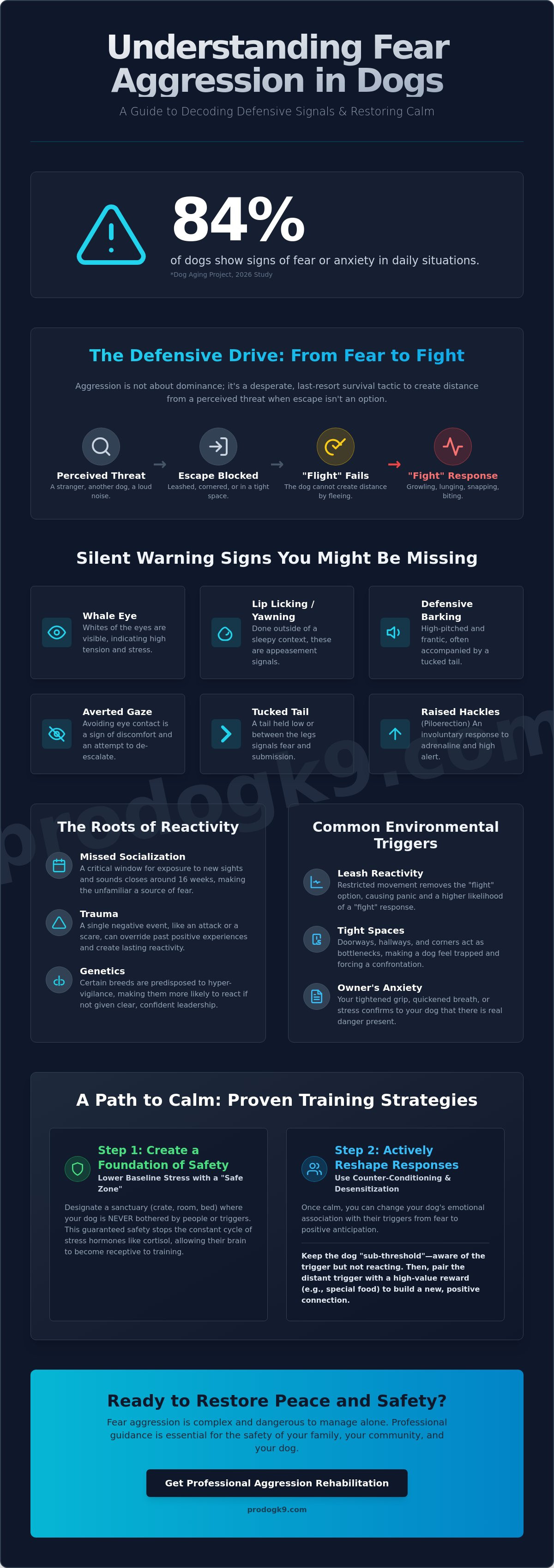
Did you know that a 2026 study from the Dog Aging Project found that 84% of dogs exhibit signs of fear or anxiety in common daily situations? It is heartbreaking to watch your companion transform from a loving pet into a lunging, growling protector the moment a stranger walks by. You feel the sting of embarrassment on every walk and the constant, heavy worry that a guest or family member might get bitten. You've likely tried treat-based distractions with little success, but effective fear aggression in dogs training requires more than just a handful of kibble.
We understand the domestic chaos you are living through. This guide will teach you how to decode your dog's defensive signals and implement professional, structured strategies to transform that volatile fear into calm, confident obedience. We will explore the mechanics of canine survival instincts, the impact of new 2026 liability laws like Ohio's Avery's Law, and the specific aggression rehabilitation techniques used by master trainers to restore peace and safety to your home. It is time to move past temporary fixes and establish the clear leadership your dog needs to feel secure.
Key Takeaways
Decode the "Flight vs. Fight" threshold to understand exactly why your dog resorts to defensive snapping when they feel cornered.
Identify how missed socialization windows and past trauma contribute to adult reactivity and learn to bridge the communication gap between species.
Implement structured "Safe Zones" and counter-conditioning as part of a professional fear aggression in dogs training plan to shift your dog's emotional state.
Discover why professional aggression rehabilitation is critical for preventing redirected bites and ensuring the safety of your family and guests.
Table of Contents
What is Fear Aggression in Dogs? Decoding the Defensive Drive
Understanding fear aggression begins with a shift in perspective. Your dog isn't trying to be the "alpha" or dominate your household; they are simply trying to survive a situation they perceive as dangerous. At its core, fear aggression is a dog's desperate attempt to create distance between themselves and a perceived threat. When a dog feels they cannot escape, their internal "flight" response hits a wall, and they pivot to "fight" as a last resort. This transition is known as defensive aggression in dogs, where the animal believes that striking first is the only way to stay safe.
Distinguish between the emotion and the action. Fear is the internal state of distress, while aggression is the outward behavior chosen to resolve that distress. Many owners struggle with fear aggression in dogs training because they focus on the snap rather than the anxiety driving it. If you only punish the growl, you remove your dog's early warning system without fixing the underlying terror. Fear aggression is a communicative survival tactic used when space is denied.
Silent Warning Signs You Are Missing
Before the first bite occurs, your dog is likely screaming for help through subtle body language. Look for "Whale Eye," where the white part of the eye becomes visible as the dog tenses up. Frequent lip licking or yawning in a non-sleepy context are also high-stress indicators. You must also learn to distinguish barking patterns; defensive barking is often high-pitched and frantic, accompanied by a tucked tail, unlike the forward-leaning stance of offensive aggression. Watch for piloerection, or raised hackles, along the spine. This is an involuntary physiological response to adrenaline, much like human goosebumps, signaling that your dog is at their emotional limit.
The Root Causes of Fear-Based Reactivity
The critical socialization window closes faster than most owners realize. If a puppy isn't exposed to a wide variety of sounds, people, and environments by approximately 16 weeks of age, they often grow up viewing the unknown as a direct threat. This lack of early exposure creates a biological deficit in confidence that manifests as adult reactivity. While early prevention is ideal, as detailed in our Puppy Training 101 guide, understanding these roots is the first step toward rehabilitation for older dogs.
Trauma serves as another powerful catalyst. A single "bad experience," such as a sudden attack at a park or a frightening encounter with a stranger, can override years of calm behavior. Genetics also play a silent but significant role. Certain breeds are hardwired for hyper-vigilance, making them more susceptible to environmental causes of fear aggression if they lack clear leadership. When a dog is genetically predisposed to be watchful, every rustle in the bushes or knock at the door becomes a high-stakes event.
Environmental Triggers in the NJ Home
Your home's physical layout often dictates your dog's stress levels. Doorways and narrow hallways act as bottlenecks where a dog feels trapped, forcing a fight response because they cannot flee. Territory markers like fences can amplify this, as the dog feels responsible for a perimeter they don't fully understand. Leash reactivity is a primary hurdle in fear aggression in dogs training. When a dog is tethered, they know their ability to create distance is gone, and this restriction of movement translates directly into panic. Don't overlook your own emotional state; your tightened grip on the leash or spike in heart rate confirms to your dog that danger is near. If your daily walks have become a source of dread, our Aggression Rehabilitation sessions can provide the professional intervention needed to restore peace.
Proven Strategies for Fear Aggression Training
Rehabilitation begins by lowering your dog's baseline stress. You must first establish a designated "Safe Zone" in your home. This is a physical sanctuary, such as a specific room or a crate in a quiet corner, where the dog is never approached, touched, or bothered by guests. By guaranteeing this space, you stop the constant cycle of cortisol production. Once the dog feels secure in their environment, you can begin the active phase of fear aggression in dogs training using counter-conditioning. This process involves pairing a distant trigger with a high-value reward to fundamentally shift the dog's emotional response from terror to anticipation.
Desensitization works alongside this by controlling the intensity of the trigger. You must keep the dog "sub-threshold," meaning they are aware of the stimulus but not yet reacting. If your dog lunges, you've moved too fast. For many owners, maintaining clear communication at these critical moments is difficult. This is where remote tools become invaluable. A professional Dogtra collar training guide can show you how to use low-level tactile cues to reach your dog's mind before their emotions take over. These tools provide a safety net, allowing you to provide guidance without the physical tension of a shortened leash.
Building Confidence Through Obedience
Obedience is the antidote to anxiety. Commands like Sit, Stay, and Place serve as mental anchors for a fearful dog. When a dog is focused on a specific task, their brain has less room to process panic. We call this "Threshold Management." Instead of the dog deciding how to handle a stranger, they learn to look to you for cues. This structured leadership replaces domestic chaos with disciplined companionship. If you are ready to build this foundation, our dog obedience training at home provides the roadmap for achieving real-world reliability. For those dealing with high-stakes behaviors, our specialized At-Home Obedience Training offers the direct, professional intervention required to transform fear into confidence.
Why Professional Aggression Rehabilitation is Essential
Attempting DIY fixes for high-stakes behavior is inherently dangerous. When owners misinterpret a dog's fear threshold, they often inadvertently trigger redirected bites. A dog in a state of panic does not distinguish between a perceived threat and the hand holding the leash. Professional fear aggression in dogs training is not just about teaching commands; it's about safety and expert risk mitigation. Our at-home sessions across Monmouth and Ocean counties provide the real-world context necessary for success. We observe your dog in the exact environment where their triggers occur, ensuring the solutions we implement work in your daily life.
A Master Trainer identifies micro-behaviors that the average owner simply misses. A slight shift in weight, a momentary freeze, or a specific ear position signals an impending outburst seconds before it happens. Catching these signals allows for proactive correction rather than reactive panic. Choosing dog aggression rehabilitation NJ is the most responsible step you can take to reclaim your home and protect your guests. Expert intervention ensures that fear aggression in dogs training is handled with the precision required for volatile cases.
The Pro-Dog K9 Academy Difference
We bring over 30 years of experience to the most difficult NJ cases. Our methodology is built on a "Balanced Approach" that pairs deep empathy for the animal's fear with clear, firm boundaries. We don't just manage the symptoms; we address the root cause to transform the relationship between owner and dog. Every case begins with a comprehensive at-home assessment where we analyze your dog's history and environmental stressors. This personalized rehabilitation plan creates a structured path forward. We move your household from a state of domestic chaos to one of disciplined companionship, where mutual respect is the foundation of every interaction.
Reclaim Your Home with Professional Leadership
Reclaiming your home from domestic chaos is possible when you replace fear with clear, structured leadership. You now understand that your dog's defensive drive is a survival tactic rather than a character flaw. By managing environmental thresholds and establishing safe zones, you've taken the first steps toward a more stable life. However, navigating the high-stakes complexities of fear aggression in dogs training requires the precision and safety of a seasoned expert. DIY methods often fall short when the risk of a bite is real.
Don't let embarrassment or worry dictate your life any longer. With over 30 years of experience, our Master Trainer Certified experts specialize in the most difficult rehabilitation cases. We serve families throughout Monmouth, Ocean, Burlington, and Mercer Counties with a balanced approach that delivers tangible results. It's time to bridge the gap between species and restore the bond of mutual respect. Schedule your At-Home Aggression Rehabilitation session with a Master Trainer today. You and your dog deserve the peace of mind that comes with disciplined companionship.
Frequently Asked Questions
Can fear aggression in dogs be cured, or just managed?
Fear aggression is rehabilitated through consistent leadership and emotional reprogramming rather than a simple medical cure. While you can't erase a biological survival instinct, you can reach a state where the dog chooses obedience over aggression. Effective fear aggression in dogs training focuses on lowering baseline stress so the dog no longer feels the need to defend themselves in everyday situations. Success is measured by reliability and the dog's ability to look to the owner for guidance during stress.
Is it okay to comfort a dog when they are acting aggressively out of fear?
You should not coddle or pet your dog while they are lunging, growling, or snapping. While your intent is to soothe their anxiety, the dog perceives this physical affection as praise for their defensive behavior. You are essentially confirming that the situation is dangerous and that their panicked response is correct. Instead, remain calm and provide a clear, neutral command to redirect their focus back to your leadership and away from the trigger.
How do I tell the difference between fear aggression and dominance?
Distinguish the two by observing the dog's center of gravity and ear position. A fearful dog tries to appear smaller, often with a tucked tail, pinned ears, and weight shifted toward the rear. Dominant aggression is characterized by a forward leaning stance, a stiff, high tail, and unwavering eye contact. Most domestic cases labeled as dominance are actually fear based reactions from dogs who feel they lack a competent leader to protect the pack.
What should I do if my dog lunges at a stranger while we are on a walk?
Immediately turn and walk in the opposite direction to create distance between your dog and the trigger. Do not stop to scold or engage in a physical struggle, as this only increases the dog's arousal and confirms their panic. Once you have reached a safe distance where the dog can focus, use a firm command to reset their mental state. This immediate removal prevents the situation from escalating and keeps you in control of the environment.
Will an e-collar make my dog's fear aggression worse?
Modern e-collars actually reduce anxiety by providing clear, low level communication when integrated into a professional fear aggression in dogs training program. The goal is never punishment. High quality tools like a Dogtra collar provide a subtle tactile cue that cuts through the mental fog of a panic attack. This allows you to reach your dog's mind without the physical tension of a tight leash, which is a primary trigger for many reactive dogs.


Comments